
Culture and consumption · In-depth guide
How the world drinks tea: traditions, serving sizes and caffeine
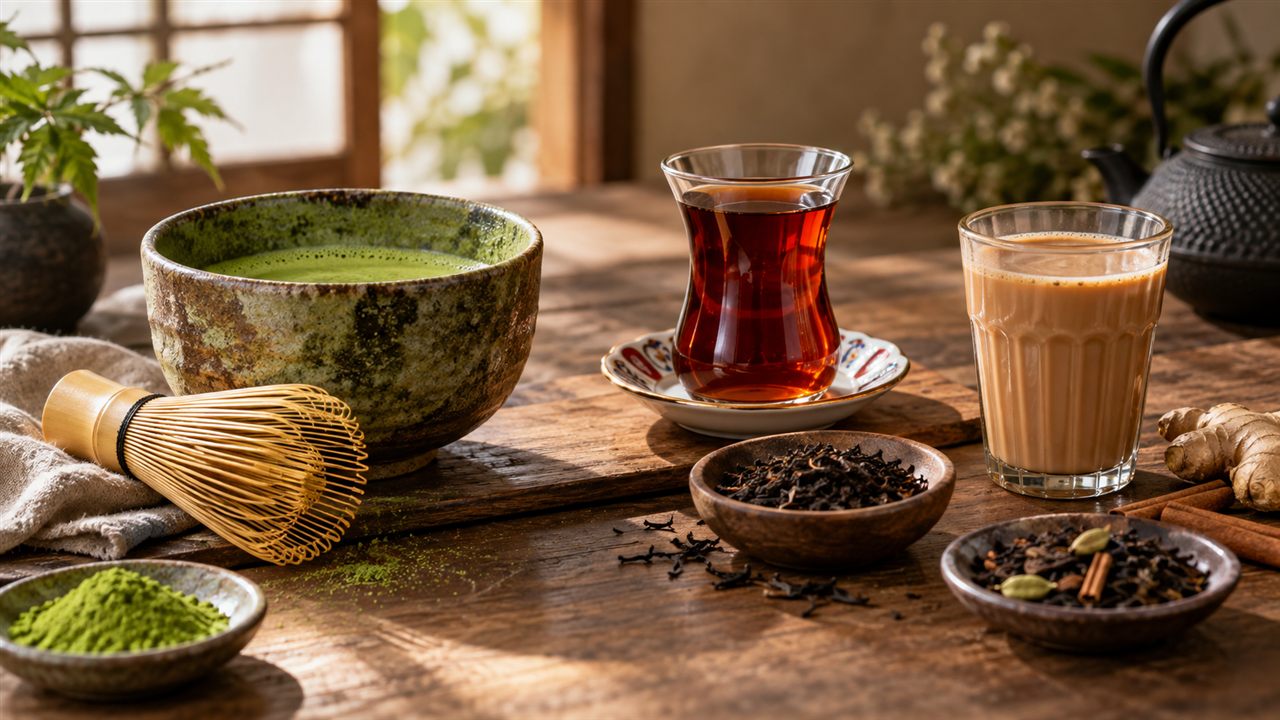
This is a guide to selected traditions, not a complete map of the world's tea cultures. Within every country, habits vary between regions, households and occasions. A formal ceremony, a street-side drink and an everyday kitchen mug can all belong to the same place without representing the same experience.
One plant, many preparations
Many familiar teas begin with Camellia sinensis, but processing and preparation produce a wide range of drinks. Black tea, green tea and matcha are not interchangeable recipes, even when a menu groups them together.
In a leaf infusion, water extracts compounds and the leaves are normally removed or left behind. With matcha, powdered leaf is suspended in the drink. These differences affect how we should think about ingredients and serving amounts.
The guide to green tea, black tea and matcha explains those distinctions in more detail. The cultural lesson is that tea is not simply hot water plus an identical bag everywhere.
Nor does a shared plant mean an identical social practice. The tools, sequence, company and occasion can be as important to the experience as the beverage.
China: processing knowledge and everyday social life
UNESCO's listing of traditional tea processing and associated social practices in China, inscribed in 2022, recognises knowledge spanning tea cultivation, processing and sharing. It describes a broad living tradition rather than one universal recipe.
That breadth matters. A country with many tea-producing regions and preparation styles cannot be reduced to a single cup in a travel photograph. Different leaves, vessels and occasions invite different ways of paying attention to tea.
For someone tasting a tea prepared through repeated small infusions, the session is often a more useful unit than the individual cup. Several small pours may come from the same leaves, and a later infusion is not necessarily equivalent to the first.
For caffeine tracking, this means the number of cups alone is incomplete. The amount of leaf and the whole session's preparation are relevant, even when an exact dose cannot be established.
Japan: matcha and the care of preparation
The Japan National Tourism Organization's tea-ceremony guide describes chanoyu or sadō and the preparation and presentation of matcha. Its account highlights a practice shaped by attention to utensils, gestures and the relationship between host and guest.
A ceremony should not be treated merely as an unusual way to deliver caffeine. The pace and context are part of its meaning. Equally, ceremonial matcha does not describe every tea drink consumed in Japan.
From a recipe perspective, powdered tea needs a different question from an infusion: how much powder is in the serving? A large matcha latte may contain more milk without proportionally more matcha, or it may use a different powder dose.
The bowl's size and the drink's green colour therefore cannot settle the caffeine amount. A café's documented recipe is more informative than assuming that every matcha drink follows a ceremonial preparation.
Türkiye and Azerbaijan: tea as hospitality
UNESCO's çay-culture listing recognises tea practices shared by Azerbaijan and Türkiye, including the role of tea in hospitality and conversation. The small, distinctive glasses are part of a wider social setting, not simply decorative objects.
Serving and refilling small glasses changes the way an occasion unfolds. The total amount consumed can be difficult to infer from the size of one glass, especially when people remain together for some time.
This is a useful example of why a photograph cannot establish intake. A single glass might represent one serving or part of a longer sequence; the preparation may be stronger or weaker than its colour suggests.
The tea-consumption guide separately discusses dated national statistics. Cultural recognition and per-person consumption are complementary subjects, but one is not a measurement of the other.
India: masala chai is a family of recipes
The Tea Board of India's masala-tea description identifies Indian black tea with spices such as cardamom, ginger and cinnamon. The combinations offer many possibilities rather than one mandatory formula.
When discussing chai, it is important to distinguish a particular household or vendor's preparation from a commercial concentrate or café menu item. Shared flavour language does not guarantee shared ingredients, proportions or caffeine.
Milk, spices and sweetness can change the sensory impression without revealing how much tea was used. A strongly spiced drink is not necessarily higher in caffeine than a milder-tasting one.
For a home recipe, recording the tea quantity and number of portions makes the preparation easier to reproduce. For a purchased drink, a relevant local recipe record is preferable to importing a figure from a different chain or country.
Morocco: mint does not necessarily mean herbal-only
The Moroccan National Tourist Office's food-and-drink guide describes green mint tea as a drink rooted in Moroccan traditions. Its hospitality page also places tea within welcoming and sharing.
For caffeine, the important ingredient distinction is that a mint-flavoured drink can contain green tea. That is different from an infusion made only from mint leaves.
Menu wording can be ambiguous outside the original setting. If you need to avoid or limit caffeine, ask what is in the drink rather than assuming that mint means caffeine-free.
The same principle applies to other herbs and flavourings. A blend can combine caffeinated tea leaves with plants that do not supply caffeine. Its aroma may foreground the herb while its caffeine still comes from the tea.
Britain: a formal tradition and an everyday mug
The Royal Collection Trust's history of tea describes the development of afternoon tea in the nineteenth century. That formal setting is one strand of British tea culture, not a description of every tea break.
An ordinary mug made quickly in a kitchen and a carefully arranged afternoon service involve different portions, food and expectations. Both can be called tea, which makes broad comparisons surprisingly difficult.
Adding milk changes the finished drink, but it does not remove caffeine already extracted from the leaves. A pale-looking cup can still contain caffeine; colour is not a reliable dose indicator.
For questions about today's balance between tea and coffee, see Britain's changing drinking habits. Historical importance does not automatically establish current serving counts.
Small cups and large mugs
A small vessel can encourage several refills; a large mug may be used only once. Comparing them by counting vessels ignores the total volume and preparation.
As an invented example, four 75 ml pours total 300 ml, the same liquid volume as one 300 ml mug. That arithmetic does not establish equal caffeine because the recipes could be completely different.
The point is not to turn every social occasion into a measurement exercise. It is to avoid making confident claims from the size of a cup.
If a personal estimate matters, note whether the drink was a single infusion, a concentrate diluted into servings or a repeated-infusion session. Those details communicate uncertainty more honestly than a generic number labelled tea.
Repeated infusions are not identical refills
When the same leaves are brewed again, the available material and extraction conditions differ from the first infusion. A later pour should not automatically be assigned the same caffeine as a fresh portion of leaves.
At the same time, a quick rinse is not a dependable household decaffeination method. The amount removed depends on conditions and cannot be inferred from a short universal rule.
Scientific measurements of specific preparations can illuminate these processes, but they apply to the tested leaves and recipes. A 2025 analytical study of tea and brewing conditions is an example of investigating preparation rather than relying only on a tea's category name.
For practical tracking, it is better to acknowledge an uncertain session total than to construct a falsely exact series of identical cup entries.
Dilution changes concentration, not what was already extracted
If a prepared tea contains a given amount of caffeine, adding water spreads that amount through a larger volume. It does not destroy the caffeine.
Suppose, purely as an arithmetic example, a concentrate contains 60 mg and is diluted to twice its original volume. The whole mixture still contains 60 mg. If it is then divided equally between two people, each portion contains 30 mg under those assumptions.
Adding milk follows the same arithmetic principle for caffeine already present. But changing the recipe can also change how much tea is used, so a larger café drink should not be assumed to be merely a diluted smaller one.
This is why product records should specify the named serving. A concentration and a total serving dose answer different questions and should be labelled separately.
Taste does not measure caffeine
Bitterness, astringency, sweetness, milk and spices all shape the impression of a drink. None is a household caffeine assay.
A delicate-tasting tea is not automatically caffeine-free, and a bitter one is not necessarily the highest-dose option. The amount consumed over the whole occasion matters alongside the concentration.
Tea colour can also be affected by processing and brewing in ways that do not provide a simple caffeine scale. Ranking black, green and powdered teas from appearance alone is unreliable.
When a numerical estimate is needed, use a relevant analytical or product source and retain its assumptions. If the source does not match your preparation, say approximate instead of allowing a precise-looking number to imply certainty.
Cultural sources and scientific sources have different jobs
A museum, heritage listing or tourism organisation can be a strong source for a described tradition or documented object. It is not automatically the right authority for a health claim about that drink.
Conversely, a laboratory paper measuring caffeine does not explain the full social meaning of a ceremony. Treating a tradition only as a chemical extraction process would miss what participants value.
This guide uses cultural sources for cultural descriptions and separates caffeine reasoning from those accounts. It does not infer disease prevention, relaxation or longevity from a practice's age or heritage status.
For health comparisons, use the tea-versus-coffee evidence guide. Long use and cultural importance are interesting facts, but they are not substitutes for appropriate health research.
Enjoying a tea tradition respectfully
Begin with curiosity rather than a checklist of supposedly authentic rules. Ask a host how they prefer to prepare and serve the tea, and avoid assuming that a short online description represents every local practice.
If you have a dietary need or prefer less caffeine, communicate it politely. Accepting hospitality does not require ignoring your own circumstances, and a smaller serving or alternative may be possible.
When adapting a recipe at home, describe it as your version rather than claiming that one simplified method represents an entire culture. It is possible to appreciate an influence without presenting yourself as its authority.
The most valuable lesson may be the attention given to the occasion: slowing down, sharing a drink or noticing preparation. Those are observations about the experience, not medical promises about what tea will do.
A practical tasting note that avoids false precision
If you want to compare preparations, record the tea name, leaf or powder quantity, water amount, brewing time and number of servings. Include milk, dilution and whether the same leaves were used again.
Add sensory notes separately: aroma, texture, sweetness, bitterness and what you enjoyed. Keeping those observations apart from caffeine estimates prevents taste from becoming an unsupported numerical claim.
You can also record the setting. A drink shared over conversation may be experienced differently from one consumed while rushing to work, even if the recipe is similar.
Such notes are useful without pretending to be a scientific study. They help you repeat a preparation and recognise changes, while leaving the actual caffeine content uncertain unless you have appropriate supporting data.
The bigger picture
Tea connects agricultural knowledge, craft, trade, hospitality and everyday routines. Its diversity is not an obstacle to understanding it; it is the reason broad assumptions need care.
A national style cannot be assigned one caffeine dose, and a cultural ranking cannot tell you what remains in your system at bedtime. For personal planning, the drink database and caffeine calculator are starting points with visible assumptions, not substitutes for a measured recipe.
The most useful question when meeting an unfamiliar tea is therefore twofold: what does this preparation mean in its setting, and what ingredients and serving are actually in front of me? Keeping both questions open makes the experience richer and the caffeine estimate more honest.
Sources and editorial scope
AI-assisted educational synthesis by CaffCalc. Sources are linked alongside the relevant discussion. This is not a systematic review or an independently clinician-reviewed article. Research years and data limitations are stated in the text; publication today does not make historical findings current measurements.
- UNESCO's listing of traditional tea processing and associated social practices in China
- Japan National Tourism Organization's tea-ceremony guide
- UNESCO's çay-culture listing
- Tea Board of India's masala-tea description
- Moroccan National Tourist Office's food-and-drink guide
- hospitality page
- Royal Collection Trust's history of tea
- 2025 analytical study of tea and brewing conditions
Health information is general education, not diagnosis or treatment advice. Read our source policy.