
Tea and health · In-depth guide
Green tea, black tea and matcha: what actually makes them different?
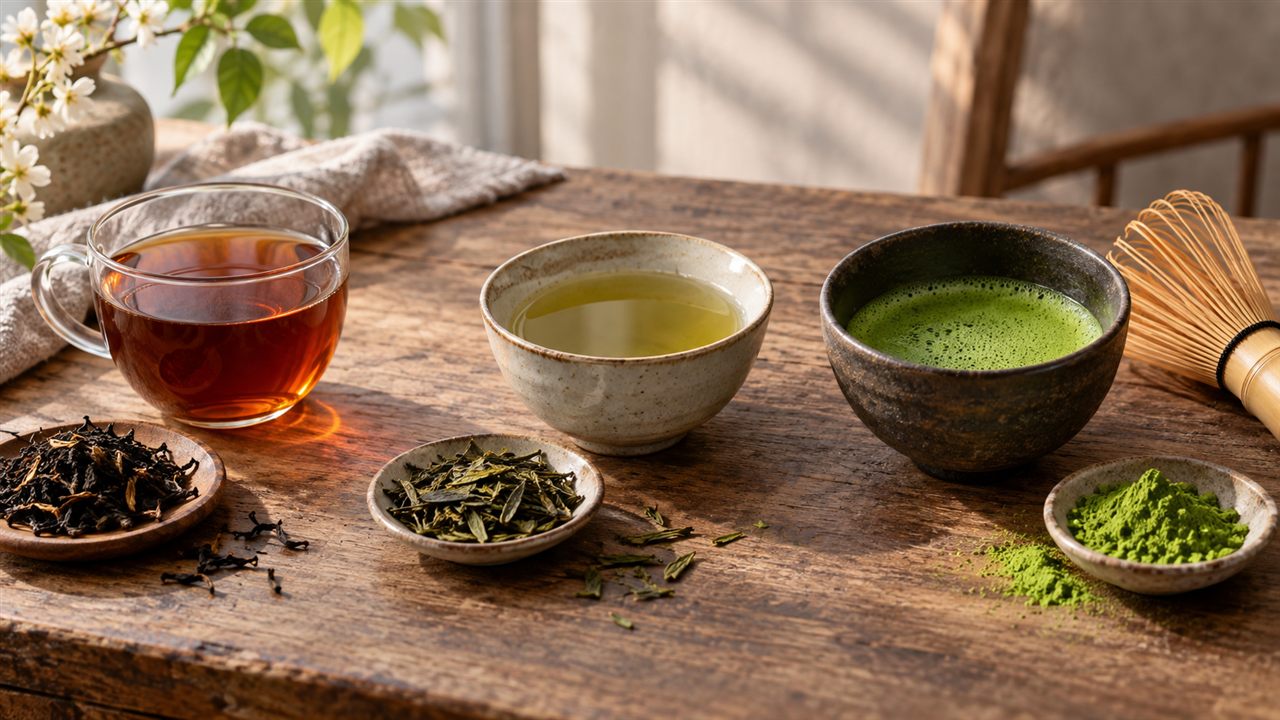
Understanding those differences makes it easier to choose a drink, interpret research and avoid exaggerated claims. This guide concentrates on everyday beverages. Concentrated tea extracts and supplements are a separate category; their evidence and risks should not be assumed to match those of a brewed cup.
One plant, several kinds of tea
Green, black, white and oolong teas are made from Camellia sinensis. Processing changes their character. Herbal infusions usually involve other plants, although blends can include tea, mate or other caffeinated ingredients. NCCIH’s overview provides the botanical distinction and an introduction to tea’s components.
The shared plant does not mean all products are chemically identical. Cultivar, growing conditions, leaf selection and processing can vary. Neither does a broad tea category capture every recipe. A bag of supermarket breakfast tea, a carefully portioned loose-leaf infusion and a café concentrate are different preparations even when all are described as black tea.
For readers comparing caffeine, the useful unit is the prepared serving. The name of the plant or colour of the finished drink is background information, not a complete measurement. That is why a useful product record should describe both the ingredient and how it is intended to be consumed.
Processing is not the same as brewing
Processing happens before the tea reaches your kitchen; brewing happens when you prepare the drink. Broadly, green-tea processing limits oxidation, while black-tea processing allows substantial oxidation. Oolong occupies a varied range between these approaches. Some tea traditions also involve microbial fermentation, which should not be confused with every use of the word oxidation.
UNESCO’s account of traditional tea processing in China documents the diversity of techniques and associated social practices. It is a useful reminder that these categories contain skilled traditions, not merely different coloured powders on a nutrition chart.
Brewing then adds its own variables: leaf quantity, water, temperature, contact time and repeated infusions. A comparison that ignores those variables can attribute a difference to the tea category when it actually comes from the recipe. This is especially important when a table combines values from unrelated studies without explaining how each drink was made.
What makes matcha different?
Matcha is prepared from finely powdered tea, which is suspended in the drink rather than removed like a tea bag. The powder quantity is therefore an important part of the serving description. A recipe using one small scoop cannot be assumed to match a recipe using several larger scoops.
There is also a distinction between the tea ingredient and a finished café drink. A matcha latte may include milk, a sweetened premix or syrup. The word matcha on the menu does not reveal the amount of tea powder or whether other ingredients have been added. Ask for the recipe or use the manufacturer’s nutrition information where available.
Powdered leaf should not be treated as a synonym for a concentrated extract capsule. Those products can have different compositions and intended servings. Their research is not interchangeable. When a health claim cites a study, check whether the participants drank a beverage, consumed powder or took an extract.
Which one contains the most caffeine?
There is no dependable universal order for every green tea, black tea and matcha serving. Product choice and preparation can produce overlapping amounts. A 2025 laboratory study of tea infusions found differences related to tea type, infusion conditions and serving form within its tested samples. Those measurements are evidence about the tested recipes, not an exhaustive ranking of all teas.
Matcha comparisons particularly need a powder weight. Infused-tea comparisons need a leaf or bag quantity and the volume consumed. A generic figure expressed per 100 ml can help compare concentration, but it should not replace the total caffeine in the serving you actually drink.
If two drinks have the same concentration and one serving is twice as large, the larger serving contains twice as much caffeine. If the concentrations differ, size alone cannot determine the answer. Use the drink database for documented records and keep homemade estimates explicitly approximate.
A serving-size example
Imagine an infused tea documented at 15 mg per 100 ml. A 200 ml serving would contain 30 mg; a 350 ml serving would contain 52.5 mg, assuming the same concentration. These are hypothetical figures illustrating arithmetic, not measured values for a particular tea.
Now imagine a powdered-tea product provides a caffeine figure per gram. The calculation starts with powder weight, not cup volume. Adding more water to the same amount of powder changes concentration but does not remove caffeine from the complete drink. Drinking only part of a well-mixed serving changes the amount consumed.
This is why comparing a small bowl with a large latte using only milligrams per 100 ml can mislead. Both concentration and total serving are useful, but they answer different questions. A clear comparison shows them separately and states which input was measured, supplied by a manufacturer or estimated.
Do antioxidants make one tea healthier?
Antioxidant language often compresses several steps into one claim: a substance exists in tea, it behaves a certain way in a laboratory, it reaches relevant tissues after consumption and it improves a meaningful health outcome. Evidence for the first step does not automatically establish the last.
An everyday decision should therefore not depend only on a product’s advertised antioxidant score. Ask what was measured and whether the evidence concerns the drink as prepared. A comparison of dry powders is different from a comparison of normal servings, and a test-tube measure is different from an outcome in people.
This does not mean tea’s compounds are uninteresting. It means the language should match the evidence. “Contains compounds being studied” is a different claim from “prevents disease”. A trustworthy guide can explain the scientific interest without promising that a particular colour of tea will transform someone’s health.
What health evidence is available?
NCCIH’s green-tea assessment describes mixed or limited evidence for several promoted uses. It also notes that many trials examining blood lipids used extracts rather than brewed tea. Findings about a concentrated preparation cannot simply be assigned to an ordinary mug or a sweetened bottled product.
For long-term outcomes, observational research can identify patterns but cannot eliminate all differences between tea drinkers and non-drinkers. People may differ in diet, smoking, activity and other behaviours. Studies from one population also may not represent another population’s recipes or drinking patterns.
The practical conclusion is modest: enjoy tea as a drink if it suits you, but do not use it as a replacement for treatment or assume more is better. Our tea-versus-coffee guide explains why a universal health winner is not supported by simply comparing separate bodies of research.
Tea extracts deserve separate caution
The word tea can make a supplement sound equivalent to a familiar beverage. It is not enough to establish that equivalence. Dose, concentration, formulation and other ingredients matter. NCCIH reports adverse effects and medicine interactions associated with some green-tea products, including uncommon liver injury reports mainly involving extracts.
Someone taking medicines or considering a concentrated supplement should ask a pharmacist or clinician rather than infer safety from their experience with brewed tea. A label describing an ingredient as natural does not answer an interaction question, and an online caffeine calculator cannot assess all the compounds in a supplement.
This guide does not recommend extracts, weight-loss products or high-dose tea preparations. It focuses on understanding drinks. Keeping that boundary clear prevents an article about an ordinary cup from accidentally endorsing a very different product with a much more concentrated exposure.
L-theanine and the promise of calm focus
Tea contains L-theanine, and studies have investigated it alone or with caffeine. But a commercial claim about calm focus needs more than the presence of both ingredients. The amounts, participants, task and comparison condition matter. A cup of tea is not a standardised research formulation.
If you feel different after tea than coffee, that experience is real as an experience, but it does not identify the cause by itself. Caffeine dose, pace of drinking, expectations, food and context may differ. You cannot infer a precise mechanism or diagnose caffeine sensitivity from a single comparison.
It is reasonable to choose the drink you prefer without turning the preference into a physiological claim. For a closer look at what attention tests do and do not show, see caffeine and concentration. The distinction between feeling focused and demonstrating a particular improvement is important for any beverage.
Brew for enjoyment, estimate with humility
Follow the product’s preparation guidance as a starting point, then adjust to taste. A scale and timer can make recipes more repeatable, but they do not measure caffeine directly. Even a carefully repeated recipe may involve natural variation in the ingredient.
Avoid relying on simple rules such as pale tea always contains less caffeine, a quick rinse reliably removes it, or a bitter taste reveals a stronger dose. These shortcuts do not provide a documented serving value. If a low or caffeine-free intake is important, a clearly specified product is more useful than trying to engineer an unknown tea into a precise target.
Repeated infusions add another complication. Each infusion is not necessarily identical to the first, and a session may involve several small cups. Record the overall pattern if you are estimating intake. Do not multiply a generic first-cup value by every refill and then describe the total as measured.
Milk, sugar and ready-to-drink products
The health discussion should reflect the complete recipe. Adding milk changes a drink’s composition; adding syrup or sugar changes it again. None of those changes can be inferred from the base tea’s reputation. A sweetened bottled green tea is not nutritionally identical to an unsweetened homemade infusion.
For a café drink, check whether sweetness comes from added syrup or from a premix that already contains sugar. Asking for no extra syrup may not remove sweetness built into the powder or concentrate. Recipes and options vary, so avoid assuming that a customisation means the same thing at every outlet.
If your aim is lower caffeine, changing milk or sweetener usually does not tell you whether the tea quantity changed. If your aim is less added sugar, the caffeine figure may stay the same. Keep these goals separate so that the swap can be evaluated on the feature you actually wanted to change.
Choosing a tea for a particular moment
For a morning drink, flavour, convenience and the documented serving may be the main considerations. For a late-evening routine, caffeine content may matter more. For a shared tea session, the total number of infusions and cups can be more informative than the size of the first cup.
There is no need to convert these choices into an elaborate ranking. A person who enjoys black tea does not need to switch to matcha because it is fashionable. Someone who dislikes coffee can choose tea without proving that it is medically superior. Preference and evidence can coexist without one being disguised as the other.
If you are following a pregnancy-related restriction or individual medical advice, count caffeine from all sources and use the relevant guidance. A green label, natural origin or traditional preparation does not exempt a drink from the same need to understand its ingredients and serving.
What to remember
Green tea, black tea and matcha differ meaningfully, but their names do not supply a complete caffeine or health assessment. Processing explains part of the story; recipe, serving and research design explain the rest. Concentrated extracts must be considered separately from beverages.
Choose a preparation you enjoy, use specific data when available and be cautious with universal claims. The world tea traditions guide explores the cultural side of the same lesson: tea is a diverse set of practices, not one standard cup that every study and every person shares.
Sources and editorial scope
AI-assisted educational synthesis by CaffCalc. Sources are linked alongside the relevant discussion. This is not a systematic review or an independently clinician-reviewed article. Research years and data limitations are stated in the text; publication today does not make historical findings current measurements.
- NCCIH’s overview
- UNESCO’s account of traditional tea processing in China
- 2025 laboratory study of tea infusions
- NCCIH’s green-tea assessment
Health information is general education, not diagnosis or treatment advice. Read our source policy.