
Tea and health · In-depth guide
Tea vs coffee: how do their health effects compare?
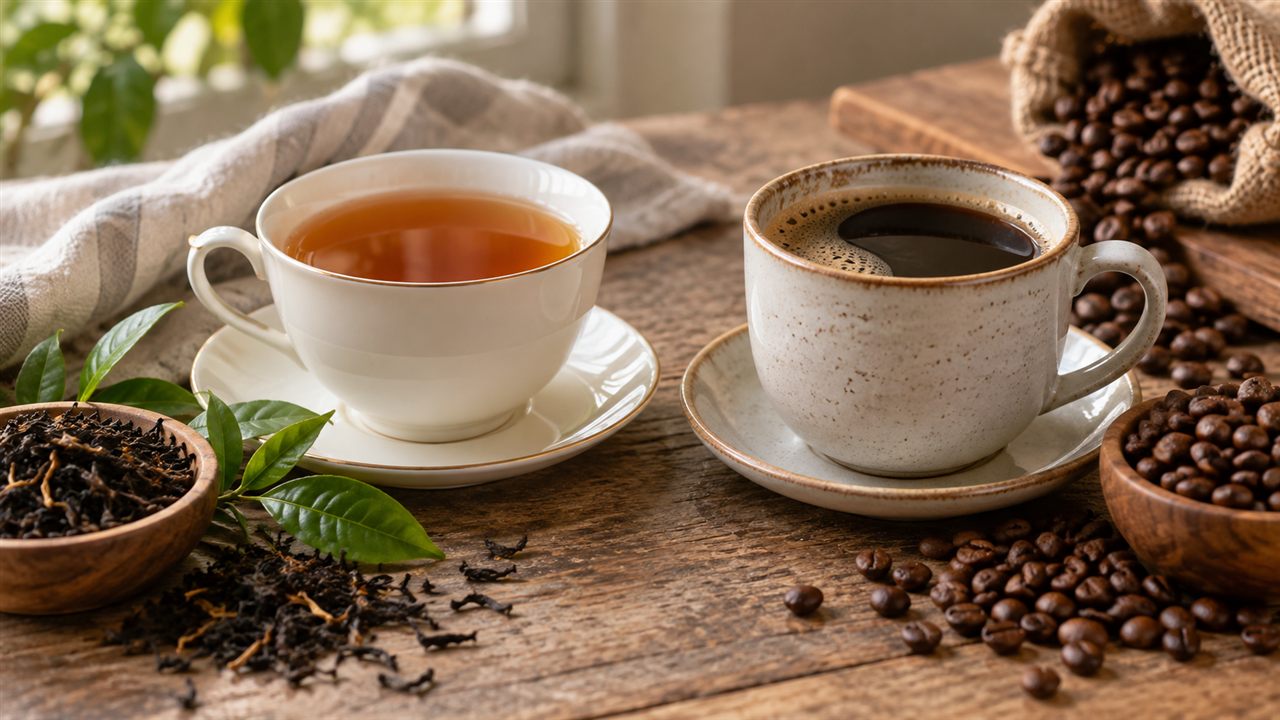
The useful question is not which team wins. It is which drink fits the purpose you have in mind: a morning ritual, a lower-caffeine afternoon option, a drink with a meal or a way to reduce a habit that no longer suits you. This guide provides a framework for making that comparison without overselling antioxidants or treating every cup as a measured dose.
Begin by comparing like with like
Write down the two actual drinks. Include the amount, preparation, additions and time of day. “Coffee versus tea” is too broad to calculate: coffee might be instant, espresso-based or filtered, while tea could mean black tea, green tea, matcha or a herbal infusion. Some herbal blends contain caffeinated ingredients, so even that label needs checking.
The same café size does not standardise the active ingredients. A larger latte might contain the same espresso shots and more milk, while a larger tea might use an additional bag. A matcha recipe depends on powder quantity rather than just the volume of water. Cup capacity is therefore a useful description, not a complete specification.
Our drink comparison tool is designed for named records and documented servings. Treat generic entries as estimates rather than exact measurements of homemade drinks. Where a recipe is unknown, acknowledging uncertainty is more useful than displaying a precise-looking number that cannot be justified.
Caffeine is one part of the comparison
Caffeine in tea and caffeine in coffee is the same molecule. The source name does not create a gentler or more powerful version of it. However, the amount consumed and the surrounding drink can differ. That distinction is why “tea caffeine” and “coffee caffeine” are not interchangeable descriptions of a dose.
For a transparent example, imagine one drink contains 40 mg and another contains 100 mg. These are hypothetical amounts, not standard tea and coffee values. Drinking three servings of the first gives 120 mg; one serving of the second gives 100 mg. The lower-dose option only produces a lower daily total if the number of servings also supports that conclusion.
Timing adds another layer. A smaller dose near bedtime may be more relevant to that evening than a larger morning dose. Use the main calculator to explore a chosen scenario, while remembering that its half-life curve is a model, not a measurement of your metabolism or a guarantee about sleep.
What tea contains beyond caffeine
Green, black, white and oolong teas come from Camellia sinensis, with different processing methods. Tea contains a mixture of compounds, including polyphenols and amino acids. NCCIH’s tea overview explains this composition and cautions that laboratory findings do not establish broad disease-prevention claims in people.
It is tempting to rank drinks by a single fashionable constituent. That misses the gap between measuring a compound and demonstrating a meaningful benefit from drinking a particular cup. A higher laboratory antioxidant reading does not directly tell you how much healthier a person will become, or whether the drink suits their sleep and digestion.
Matcha adds another complication because powdered leaf is consumed rather than removed after infusion. That changes the preparation, but does not justify assuming that any commercial matcha latte contains a standard amount of tea. A recipe with a small powder portion and substantial syrup is different from a traditionally prepared bowl. Read the actual ingredients and portion.
What coffee research can and cannot show
Coffee research includes large observational studies, short trials and reviews covering different outcomes. Our coffee health guide explains why favourable associations should not become claims that coffee prevents disease. The comparison group, population and definition of a cup are central to interpreting the findings.
To decide whether coffee is better than tea, ideally we would want research comparing the two under relevant conditions. Separate studies in different populations cannot simply be placed side by side and treated like a head-to-head competition. Differences in age, smoking, diet, location and measurement can affect the apparent results.
Even direct comparisons need a clear endpoint. One drink could suit someone’s caffeine preferences while another suits their taste or budget. There is no scientifically validated score that merges all these considerations into a universal winner. A useful comparison keeps the dimensions separate so the reader can choose which ones matter.
Do either prevent diabetes or heart disease?
A systematic review of coffee, decaf and tea found associations with lower diabetes incidence, while explicitly identifying possible bias and the need for randomised evidence. It is an example of promising population research, not a prescription to increase either beverage or replace established prevention and treatment.
Similarly, NCCIH’s green-tea assessment distinguishes limited evidence for some outcomes from the much stronger claims often used in marketing. Studies of extracts are not automatically evidence for an everyday cup. A concentrated supplement, a brewed tea and a sweetened bottled drink represent different exposures.
For someone managing a diagnosed condition, individual clinical advice is more important than choosing the apparent winner in a general article. Do not alter medication because a drink is described as protective. If a headline promises disease prevention, look for the study design and the actual product before deciding how much confidence to place in it.
What about hydration?
Both drinks contribute water. NHS everyday hydration guidance includes tea and coffee among drinks that count towards fluid intake. This does not mean either should be the only thing you drink, or that more caffeine is the answer to thirst.
Fluid contribution and caffeine tolerance are separate questions. You might prefer water because it avoids stimulant effects, cost or preparation, even though tea and coffee also provide fluid. Equally, a person who enjoys an ordinary cup does not need to treat its entire water content as cancelled out by caffeine.
Illness, prolonged exercise and medical fluid restrictions require different considerations from routine daily drinking. Our coffee and hydration guide discusses those boundaries. A general statement about fluids should not be used to override advice about dehydration treatment or an individual health condition.
Sleep and sensitivity may decide the choice
The most useful distinction for some people is how much caffeine their chosen serving contains and when they drink it. Replacing a late strong coffee with a lower-caffeine tea could reduce intake, but replacing it with several mugs or a concentrated matcha may not achieve the intended change.
Avoid using taste as a dosing tool. A mild, milky or sweet drink can still contain substantial caffeine, while a strongly flavoured decaf can contain much less. Nor is the absence of a noticeable buzz proof that caffeine has disappeared. Subjective experience and remaining caffeine are not identical measures.
If you want to change an afternoon routine, identify the documented dose of your current option and the proposed replacement. Then consider serving frequency and timing. A genuinely caffeine-free drink may be simpler if your objective is to remove caffeine from that part of the day, but check blends and product labels rather than assuming.
Added ingredients can change the practical comparison
The base beverage is only part of an order. Sugar, syrups, milk, cream and toppings can change the overall food-and-drink profile. This is a reason to read recipes, not to dismiss either drink category. A plain tea and an elaborate coffee are not evidence that all tea is nutritionally preferable to all coffee.
Milk also makes cup size a poor proxy for caffeine in espresso-based drinks. If a café keeps the same shot count across two sizes, choosing the smaller size may reduce milk without reducing the coffee dose. Tea bags, concentrate pumps and matcha scoops can follow different size rules.
When comparing at home, decide whether you want to preserve flavour, ritual, cost or caffeine. You might change just the caffeinated ingredient while keeping the cup and milk. That makes the comparison easier to understand than changing every part at once. It also helps avoid disappointment when a theoretically healthier swap is something you do not actually enjoy.
Digestive comfort is individual
Some people find a particular drink uncomfortable and another easier to tolerate. That observation is relevant, but it is not a diagnosis and does not prove that one ingredient explains everything. Temperature, volume, food, milk and other additions can vary alongside caffeine.
The NIDDK guidance on reflux and diet discusses identifying personal triggers rather than claiming that the same foods affect everyone. If you have persistent symptoms, discuss them with a healthcare professional. A switch to tea or decaf is not a substitute for investigating concerning symptoms.
Do not assume a drink labelled natural, low acid or stomach friendly has been clinically tested for your condition. Marketing terms can describe processing or flavour without demonstrating a health outcome. A clear ingredient list and a modest claim are often more useful than a reassuring label that lacks supporting evidence.
Cost, convenience and enjoyment also matter
An everyday choice needs to work in real life. A drink that is easy to prepare, affordable and enjoyable may be more sustainable than an elaborate routine adopted because of a headline. These are practical considerations, not medical benefits, but they shape whether a change lasts.
Compare cost per drink you actually make rather than just packet price. A box of tea bags, a bag of beans and a jar of instant coffee have different serving yields. Equipment, wasted batches, milk and purchased café drinks can matter more than the price of the dry ingredient alone.
There is also no need to choose a permanent identity. You can enjoy coffee in one context, tea in another and caffeine-free drinks elsewhere. The question is whether the overall routine fits your preferences and any relevant advice, not whether you consistently defend one beverage against the other.
A worked comparison without a made-up winner
Consider an imaginary person who drinks a morning coffee and wants an afternoon alternative. The current afternoon serving is documented at 120 mg. A candidate tea is documented at 35 mg for the preparation they intend to use. Replacing one serving with one serving would reduce that occasion’s caffeine by 85 mg. Those are illustrative inputs, not claims about a brand.
Now change the scenario: the person makes three teas across the afternoon. That becomes 105 mg, distributed over a longer period. The first swap and the second routine are not equivalent. A simple single-serving comparison would miss the difference, which is why recording the actual pattern matters.
The arithmetic says nothing about cholesterol, digestive comfort or the person’s sleep outcome. It answers one narrow question correctly. Good comparisons work this way: establish a measurable difference, state what it means and avoid attaching unrelated health promises to it.
Questions worth asking before choosing
Ask whether your goal is lower caffeine, a different flavour, less added sugar, easier preparation or a response to medical advice. Then check whether the proposed drink actually changes that feature. An attractive package or a fashionable ingredient may not address your goal at all.
Ask which parts of the comparison are known. Manufacturer caffeine data for a named serving is different from a generic database value, and both are different from a laboratory measurement of your cup. If you cannot establish an exact quantity, use an estimate openly rather than pretending uncertainty has disappeared.
Finally, ask whether you need a comparison at all. Someone who enjoys an ordinary drink without a specific problem does not have to optimise every cup. Evidence can inform a choice without turning a pleasant daily ritual into a continuous health experiment.
The bottom line
Tea and coffee are diverse families of drinks. Neither wins every comparison, and neither guarantees disease prevention. The most defensible decision looks at the actual serving, caffeine, preparation, additions, timing and personal circumstances rather than relying on a broad health halo.
For more detail, explore green tea, black tea and matcha, decaf coffee and the drink database. Use the evidence to make a choice that fits your life, not to chase a universal best drink that the research cannot supply.
Sources and editorial scope
AI-assisted educational synthesis by CaffCalc. Sources are linked alongside the relevant discussion. This is not a systematic review or an independently clinician-reviewed article. Research years and data limitations are stated in the text; publication today does not make historical findings current measurements.
- NCCIH’s tea overview
- systematic review of coffee, decaf and tea
- NCCIH’s green-tea assessment
- NHS everyday hydration guidance
- NIDDK guidance on reflux and diet
Health information is general education, not diagnosis or treatment advice. Read our source policy.