
Culture and consumption · In-depth guide
From coffee houses to energy drinks: how caffeine became an everyday habit
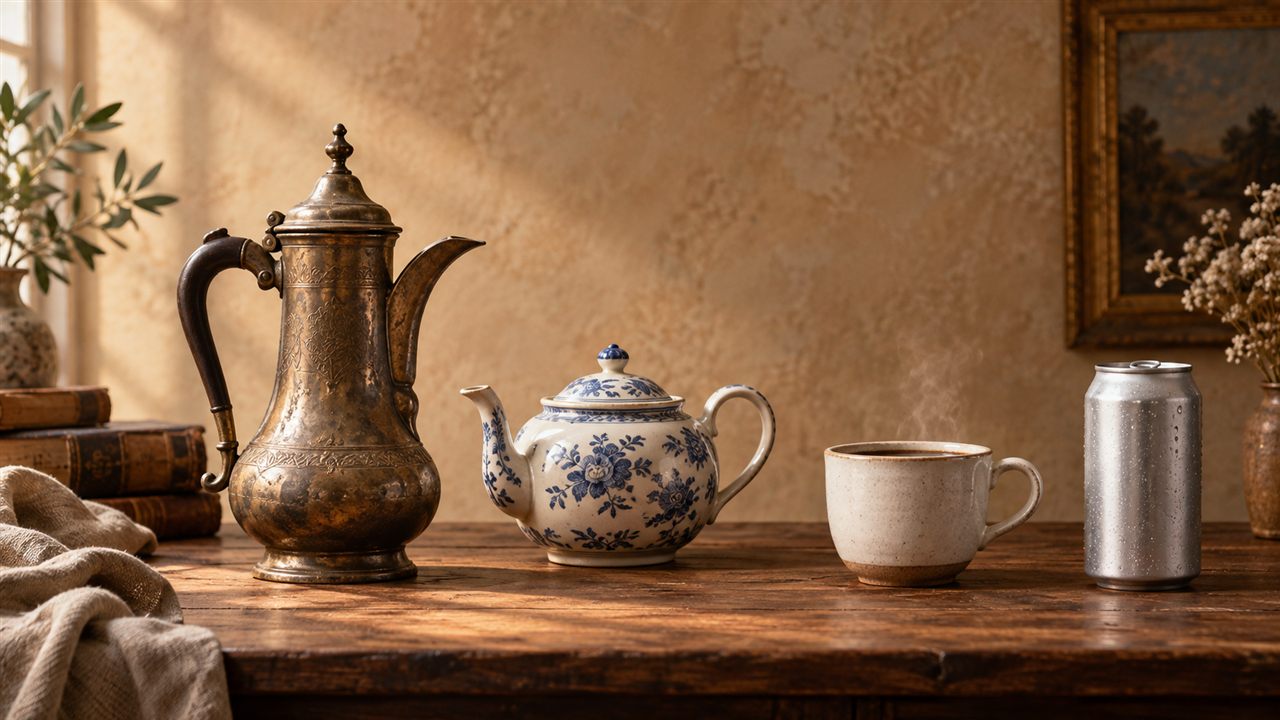
This is a selective history with a British and international-trade emphasis, not an exhaustive account of every caffeinated plant. It separates documented examples from sweeping claims about productivity or progress. The people who grew, transported, served and consumed these products belong in the story alongside famous cafés and brands.
Beverages came before the chemical explanation
People prepared and shared caffeinated plants long before modern chemistry identified caffeine as a substance. It is therefore misleading to imagine that historical drinkers chose products using the categories printed on today's labels.
They encountered tastes, rituals, perceived effects and social conventions. A drink could be valued for hospitality, medicine, status, work or pleasure, with meanings that changed between settings.
The American Chemical Society's caffeine profile provides a modern chemical reference point. Knowing the molecule helps us connect different products, but it should not erase the distinct histories of the plants and practices that contain it.
A history of caffeine is consequently broader than a history of coffee. Tea and cocoa are not side notes simply because coffee supplied the modern English name.
Why origin legends need a label
Many familiar foods and drinks have memorable discovery stories. They are effective because they turn a complicated history into a scene with a named person, a surprising event and a clear beginning.
That storytelling structure is not evidence. A legend may reveal how a community or later writer explains a tradition, but it should not be presented as a securely documented first consumption.
The cautious approach is to distinguish early surviving records, archaeological or material evidence, and later narratives. Each answers a different question, and none automatically identifies the first human experience of a plant.
This guide does not assign a single moment when humanity discovered caffeine. The more defensible history follows documented practices and institutions while acknowledging that earlier everyday use can be difficult to recover.
Coffee as a shared social practice
UNESCO's account of Turkish coffee culture describes fine grinding, slow preparation, small cups and communal customs. The heritage listing recognises hospitality and social interaction as well as brewing technique.
That account is a reminder that a coffee tradition is not merely a recipe. The invitation, conversation and transmission of knowledge can be central to its meaning.
It also cautions against a simple story in which coffee becomes important only after reaching western European commercial centres. Those centres were part of a wider history of exchange, not the starting point of coffee culture.
For modern caffeine estimates, small serving vessels still need recipe information. Historical importance does not establish one universal dose for a named preparation.
British coffee houses and information
Royal Museums Greenwich's maritime-history account describes coffee houses as places where news and business circulated. Lloyd's Coffee House became associated with shipping information and marine insurance.
The important point is the institution around the drink. People gathered, exchanged information, formed relationships and made decisions. Coffee was part of the setting, but the record does not isolate caffeine as the cause of those developments.
Claims that a stimulant created modern finance or caused an intellectual revolution therefore go beyond what such examples establish. Social access, commerce, literacy, shipping and political conditions also belong in the explanation.
A more modest conclusion is still interesting: a beverage helped organise spaces in which information and business could circulate. The physical place and the people using it mattered as much as the cup.
Tea entered an already changing social world
The Royal Collection Trust's history records tea appearing in British coffee houses in the 1650s and becoming fashionable at court later in the seventeenth century. Its account also connects tea services with status and sociability.
The overlap is striking. A coffee house could introduce tea; a domestic tea service could express wealth; a drink could move between public commerce and private hospitality.
Those examples challenge the idea that tea and coffee have always represented opposing national identities. Their histories involve competition, coexistence and changing occasions.
The museum objects also show the limits of surviving evidence. Expensive vessels are more likely to be preserved and displayed than ordinary preparations, so material collections should not be mistaken for a complete picture of everyone's drinking.
Trade routes were part of the drink
A cup consumed far from where its ingredients grew depended on transport, storage, finance and trade. Those systems influenced availability, price and the forms in which products reached customers.
Royal Museums Greenwich's account of Cutty Sark and the tea trade describes the ship within the commercial movement of tea. The story of a fast vessel is also a story about competition and the value attached to getting a commodity to market.
It is easy to romanticise the journey while overlooking the people and institutions that made it possible. Sailors, dock workers, merchants and producers performed different roles under unequal conditions.
The beverage in a drawing room was therefore connected to a much larger system. Treating it only as a pleasant consumer habit leaves out much of its historical significance.
Empire and labour cannot be left outside the frame
The museum essay A cup of char situates tea within Britain's wider maritime and imperial history. Such context matters because the growth of consumption was not separate from power, coercion and unequal trade.
The history of sweetened drinks also needs the history of sugar and the labour systems behind it. A comfortable ritual at the point of consumption can coexist with exploitation elsewhere in the supply chain.
This does not mean every cup should be reduced to a single moral lesson. It means an honest history should include the conditions of production and exchange rather than narrate only the preferences of wealthy consumers.
When reading a celebratory account of a famous brand or trading company, ask whose experience is visible and whose is absent. That question often reveals the limits of the narrative more clearly than its dates do.
Everyday habits are harder to document than famous events
Opening dates, patents and company launches are relatively easy to turn into timelines. The slow development of a household routine is harder to date.
People may adopt a product gradually, prepare it differently from advertised recipes or combine old and new habits. A new machine does not instantly replace every older method, and a popular café does not represent all drinking at home.
This makes the word first particularly demanding. The first surviving advertisement is not necessarily the first sale. A patent documents a claimed invention, not automatic mass adoption.
Historical writing becomes more trustworthy when it names the event precisely. A launch in a specified market is a better claim than an unsupported declaration that a company invented an entire way of drinking.
Preparation technology changes the questions
Different preparation methods alter how people buy, make and serve coffee or tea. A shared pot, a single-serving device and a ready-to-drink bottle organise the routine in different ways.
Convenience can change where a drink is consumed and how much recipe information the consumer sees. A homemade preparation makes some choices visible, such as the amount of coffee used; a purchased drink shifts those choices to a producer or café.
From a caffeine perspective, neither setting is automatically more transparent. A café may publish a serving figure, while a home recipe may remain unmeasured. A labelled bottle may be easier to estimate than a vaguely described mug.
The coffee-brewing guide explores these modern measurement problems. Technology can standardise parts of a process without making every serving identical.
Decaf separates part of the habit from the stimulant
Decaffeination makes an important conceptual distinction: coffee can remain a beverage and a social routine while its caffeine content is reduced.
That does not mean every property of regular and decaf coffee is identical, or that decaf contains no caffeine. It means enjoyment, taste, preparation and stimulation need not be treated as one inseparable package.
The National Coffee Association's explanation of decaf processing describes different methods used to remove caffeine. As an industry source, it is useful for process context rather than as independent proof of broad health benefits.
For the evidence and practical limitations, see our decaf guide. A historical account should avoid turning a processing innovation into a universal medical recommendation.
Manufactured drinks make caffeine more explicit
In many modern products, caffeine is presented as a named feature rather than merely an incidental property of a familiar plant. That changes the language of advertising and the way customers compare products.
For a dated example, Red Bull's company history places its Austrian launch on 1 April 1987. This is a company's account of its own launch, not independent evidence that no earlier caffeinated functional drink existed.
That distinction is important. Brand histories often frame developments in terms of invention and leadership. A responsible summary can use a documented launch date without adopting every promotional claim around it.
The broader change is visible in the product category: consumers can choose a packaged drink partly because caffeine is advertised. The label and serving amount then become central to understanding what is consumed.
Energy is a marketing word as well as a scientific one
An energy drink's name can blur several ideas: calories, subjective alertness, physical performance and reduced sleepiness. They should not be treated as synonyms.
A sugar-free caffeinated drink illustrates the distinction. It can contain caffeine without supplying the sugar-related calories of another version. Conversely, a caloric drink need not contain caffeine.
This is not merely a modern semantic problem. Historical advertisements also attached broad promises to foods and drinks. Claims need to be assessed in their context and against appropriate evidence, not accepted because they are memorable.
Our sugar-free versus caffeine-free article keeps the ingredients separate. A product's narrative is part of its cultural history, but not a substitute for its composition.
Work and alertness: avoid a single-cause history
Caffeine can affect alertness, but that does not establish that it caused a society to become more productive. Historical changes in work involve technology, institutions, labour conditions, education and many other factors.
It is also possible for a stimulant to be used in response to demanding schedules rather than to create those schedules. Cause and response can be difficult to disentangle.
Modern attention experiments answer narrower questions under controlled conditions. They cannot retrospectively prove a broad historical claim about economic development.
The concentration guide explains the difference between short-term test performance and real-world achievement. Keeping that distinction in mind makes both the science and the history more credible.
A timeline is a selection, not the whole story
| Example | What it documents | What it does not prove |
|---|---|---|
| Seventeenth-century British coffee houses | Social and commercial gathering places | Caffeine caused modern commerce |
| Tea in courtly and domestic collections | Particular fashions and practices | Every household drank the same way |
| Tea-trade shipping | A commodity's transport and market context | Trade benefited everyone equally |
| A named energy-drink launch | A product entering a particular market | The first caffeinated drink of its kind worldwide |
The omissions matter as much as the entries. A short timeline cannot adequately represent every producing community, Indigenous practice or household routine. It should state its scope rather than imply that unlisted traditions did not exist.
This article uses selected examples to explain recurring themes: preparation, sharing, commerce and measurement. It is an invitation to explore further, not a claim to have completed the subject.
What the history changes about today's cup
Knowing the history does not tell you how much caffeine is in a drink, but it helps explain why labels and habits are not purely chemical decisions. People choose drinks for taste, identity, convenience and company as well as perceived effects.
That is useful when changing a routine. Someone reducing caffeine may want to preserve the shared break or familiar preparation, rather than abandon everything associated with the drink.
It also encourages better questions about sources. Who produced the ingredient, who prepared the serving, what does the label establish and what remains uncertain? Those questions connect the historical supply chain with a present-day choice.
For a numerical estimate, use the caffeine database. For the wider story, remember that no milligram total can capture all the meanings people have attached to tea, coffee and cocoa.
The enduring thread
Caffeine became familiar through many products and practices, not through one inevitable march towards stronger stimulation. Traditions continue alongside new formats, and people can value a drink without wanting more caffeine.
The most trustworthy history keeps that diversity visible. It distinguishes a source's documented event from its promotional interpretation, includes trade and labour as well as consumption, and leaves origin legends labelled as legends.
Today's practical lesson is similarly modest: understand the actual drink, preserve what you value about the routine and do not let a cultural reputation stand in for evidence about dose or health. The world tea traditions guide offers another way to explore that balance.
Sources and editorial scope
AI-assisted educational synthesis by CaffCalc. Sources are linked alongside the relevant discussion. This is not a systematic review or an independently clinician-reviewed article. Research years and data limitations are stated in the text; publication today does not make historical findings current measurements.
- American Chemical Society's caffeine profile
- UNESCO's account of Turkish coffee culture
- Royal Museums Greenwich's maritime-history account
- Royal Collection Trust's history
- Royal Museums Greenwich's account of Cutty Sark and the tea trade
- museum essay A cup of char
- National Coffee Association's explanation of decaf processing
- Red Bull's company history
Health information is general education, not diagnosis or treatment advice. Read our source policy.