
Caffeine science · In-depth guide
Coffee brewing and caffeine: espresso, filter, cafetière and cold brew
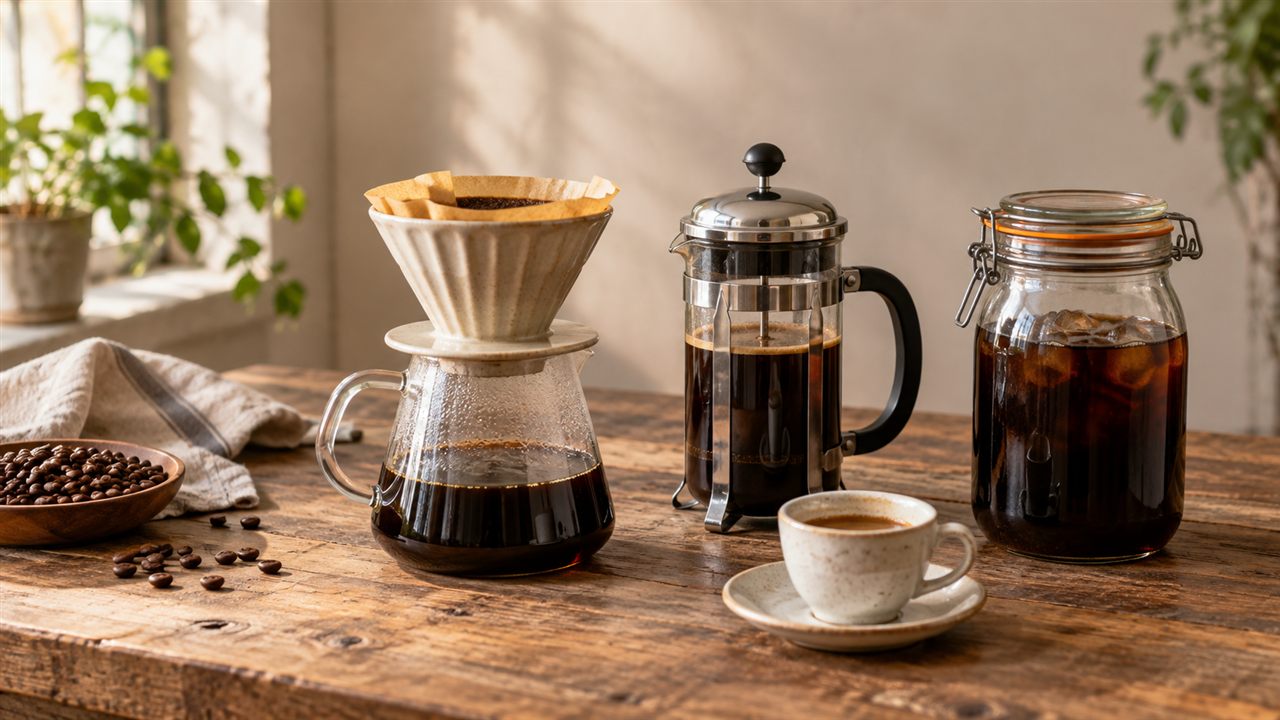
Start with dose, concentration and serving
Three quantities are frequently confused. The dry dose is the weight of ground coffee used. The caffeine concentration describes how much caffeine is present in a given amount of the finished drink. The serving dose is the total caffeine in the amount you consume. Each answers a different question.
A small drink can be concentrated without containing more caffeine than a much larger, weaker-tasting drink. Likewise, a large mug does not necessarily contain more than a small mug if both were made from the same extracted coffee and only water was added. Size and strength need definitions before comparisons become useful.
When you see a claim that one method is strongest, ask strongest by what measure. Flavour intensity, caffeine per 100 ml and caffeine per serving are not synonyms. A good comparison names the recipe and denominator instead of relying on a word that can mean several things at once.
What a controlled comparison found
A study published in Food Research International in 2019 compared eight extraction methods using the same starting coffee material. Espresso had the highest caffeine concentration among the preparations studied. However, the per-cup comparison changed when the researchers accounted for the different serving volumes used in their analysis.
In that experiment, cold brew supplied more caffeine per cup than espresso under the specified portions. The important lesson is not that every cold brew beats every espresso. It is that a concentration ranking can differ from a serving ranking, and the study's recipes and volumes belong alongside its results.
A controlled preparation is useful because it reduces some sources of variation. It also limits what can be claimed about an unrelated café. A different blend, machine setting, extraction recipe or serving can produce a different comparison. The study is evidence about its tested conditions, not a universal menu database.
Espresso: small does not mean caffeine-free
Espresso is served in a comparatively small volume, making the distinction between concentration and total dose particularly important. A menu's shot terminology is not enough to establish milligrams. The amount of dry coffee, the extraction and what the café counts as a single or double all need context.
For a latte or cappuccino, adding ordinary milk changes volume and taste but does not remove the caffeine already extracted into the espresso. A larger milk-based drink may contain the same shots as a smaller one, or the recipe may add another shot. The actual recipe determines which comparison applies.
Ask about shot count and use the chain's published caffeine information where available. Do not transfer an espresso value from one brand to another without qualification. Our extra-shot guide illustrates why apparently simple customisations need brand and serving context.
Filter coffee: the pot is not the portion
Filter brewing commonly produces enough liquid for more than one serving. The caffeine in a whole carafe and the caffeine in a mug poured from it are therefore different quantities. If you refill the mug several times, a one-cup entry may understate the amount actually consumed.
Record the dry coffee and the final drink yield if you want a consistent home recipe. That improves repeatability, but it does not by itself measure caffeine. You still need relevant composition and extraction information to turn those weights into a verified milligram value.
Paper filtering also raises a separate question about coffee oils. That is discussed in our coffee and cholesterol guide. Do not confuse a discussion of retained oils with a claim that paper makes a normal coffee decaffeinated. Different components require different evidence.
Cafetière: describe the recipe before comparing
A cafetière, also called a French press, is a brewing vessel rather than a fixed caffeine serving. Its advertised cup capacity may not match the size of your mug. A person who empties a small press into one large cup has consumed a different amount from someone sharing that press among several people.
Grind, coffee dose, water, steeping conditions and final yield can vary between households. The fact that a recipe tastes familiar does not establish its exact caffeine content. Equally, changing the vessel without changing the coffee and serving information does not give a dependable reduction percentage.
For a practical comparison, write down what you actually do. “Twenty grams of this coffee, brewed this way and divided between two mugs” is a more useful recipe description than “two coffees.” It still needs a source or measurement for caffeine, but at least the serving is no longer ambiguous.
Cold brew: concentrate and ready-to-drink are different
Cold brew describes a preparation approach, not one standard strength. A homemade concentrate intended for dilution is different from a bottled ready-to-drink product. Comparing them by equal volume before dilution can produce a dramatic-looking result that says little about the amount eventually consumed.
Research on time, roast and grind in cold brewing examines how extraction conditions influence the resulting drink. It does not support assigning every cold brew a fixed multiplier relative to hot coffee. A long steep is one part of a recipe, not a complete caffeine label.
Check whether a commercial figure applies before or after the recommended dilution. For a homemade recipe, keep the concentrate yield and serving instructions together. A screenshot of a caffeine concentration without its preparation notes can be actively misleading when copied into another context.
Dilution changes concentration, not the caffeine already present
Consider a hypothetical concentrate containing 200 mg caffeine in 100 ml. Adding 100 ml of water produces 200 ml containing the same 200 mg, assuming the whole mixture is retained. The concentration has halved, but drinking all of it still supplies the same total caffeine as the original concentrate.
If you divide that mixture evenly into two 100 ml servings, each contains 100 mg. If you drink just one, you consume less because you have consumed a smaller share of the total, not because the water destroyed caffeine. These are illustrative numbers, not a measured cold-brew recipe.
The same reasoning applies when an espresso is extended with water. An Americano can taste less intense than the original shots while containing their caffeine. If the larger menu size adds more espresso as well as more water, however, the total changes. Always identify which ingredient changed.
What roast labels do and do not tell you
Terms such as strong, intense or dark describe product positioning and sensory characteristics, not a standard caffeine measurement. A roast-intensity scale on a packet should not be read as a milligram scale unless the manufacturer explicitly defines and supports such a relationship.
Comparisons also depend on how the dry coffee is measured. A scoop is a volume, whereas grams measure mass. Changes in bean properties or grind can make equal-looking scoops different amounts of coffee. Weighing a recipe can improve consistency without making a claim about the exact caffeine in those grams.
The defensible question is not simply whether light or dark roast wins. Ask which coffee, how much of it, prepared how, and consumed in what serving. Without those details, a confident roast ranking often promises more information than the label or experiment actually provides.
Grind, temperature and contact time are connected
Brewing variables do not operate in isolation in a real kitchen. Changing the grind can change flow through a filter; changing a recipe's water or contact time can change both extraction and the final drink. A single adjustment does not always have a simple, universal effect that transfers between brewers.
This is why we do not offer a calculator that converts steeping minutes directly into exact caffeine. Such a tool would need a validated model for the relevant coffee and preparation. A visually precise result based on guessed extraction would be less useful than a transparent admission that the value is unknown.
If you change a home recipe, document the practical result and use manufacturer evidence where available. Consistency can help you compare your own routine, but it does not transform taste into a laboratory assay. Avoid extrapolating a small experiment into every bean, roast and brewing device.
Total dissolved solids are not a caffeine test
Coffee enthusiasts sometimes measure total dissolved solids to help understand brewing. That measurement relates to the mixture of dissolved material, not caffeine alone. It should not be pasted into a caffeine formula as though every dissolved compound contributed the same proportion across all coffees.
A richer-looking drink can contain many substances responsible for taste, colour and body. Those characteristics can be useful for choosing a recipe you enjoy, but they are not a validated substitute for a caffeine analysis. More technical equipment does not automatically answer a different chemical question.
When a seller claims a precise caffeine amount from an indirect measurement, look for the validation behind the method. Which coffees were tested, against what reference, and with what error? If those details are unavailable, treat the number as a claim requiring support rather than a confirmed fact about your mug.
Decaf and half-caf need their own inputs
Switching to decaf changes the starting coffee, not just the brewing method. Decaffeinated coffee can retain some caffeine, so a normal-coffee estimate should not be applied unchanged, but zero should not be assumed either. Use product-specific information where it exists and keep serving size visible.
A half-caf blend also needs a definition. Equal weights of two coffees do not necessarily mean exactly half the caffeine of the original drink, because the components may differ and decaf may retain caffeine. A café may instead define half-caf by shot preparation, adding another practical distinction.
Our half-caf versus decaf guide and half-caf calculator explain assumptions. These can help compare known inputs; they cannot measure an unknown blend. If reducing intake for a medical reason, ask an appropriate professional how much uncertainty is acceptable for your circumstances.
A comparison table that keeps the unknowns visible
| Preparation | Useful detail to check | Common comparison mistake |
|---|---|---|
| Espresso-based drink | Published caffeine and actual shots | Equating cup volume with extra coffee |
| Filter coffee | Brew yield and amount poured | Counting a whole pot as one ordinary cup |
| Cafetière | Dry dose, yield and shared portions | Treating vessel capacity as a standard serving |
| Cold brew | Concentrate or ready-to-drink status | Comparing undiluted and prepared volumes |
| Decaf or half-caf | The actual coffee and blend definition | Assuming zero or an exact halving |
This is intentionally a checklist rather than an unsupported league table. A reliable ranking would need comparable measurements for defined recipes. Without those, filling every cell with a single number creates apparent certainty at the expense of accuracy.
How to compare two real drinks
First, decide whether you care about concentration or the dose in your usual serving. For intake planning, the latter is normally the relevant quantity. Find a source for each exact drink, check its date and market, and make sure customisations have not changed the recipe described.
Next, put both values on the same basis. A hypothetical 150 ml drink at 40 mg per 100 ml contains 60 mg. A hypothetical 300 ml drink at 30 mg per 100 ml contains 90 mg. The second is less concentrated but delivers more caffeine when the full serving is consumed.
Finally, keep uncertainty in the result. If one number is manufacturer-published and the other is a generic estimate, say so instead of ranking them to a decimal place. Our drink comparison tool can help with documented database entries, but a missing value remains a missing value.
Choosing a method without a false health promise
Choose equipment for a recipe you enjoy, a serving you understand and a routine you can maintain. Price, appearance and brewing complexity do not guarantee a better caffeine outcome. A simple known product may be easier to track than an elaborate recipe with several unverified assumptions.
If your aim is less caffeine, consider the actual coffee, portion and frequency rather than relying on a method name. If your aim is better sleep, timing is another separate variable. If your concern is cholesterol, preparation and filtration raise a different evidence question from caffeine alone.
The useful conclusion is not that one brewer wins. It is that meaningful comparisons describe the whole drink. Keep concentration separate from total dose, distinguish dilution from removing caffeine, and prefer a sourced range or an honest unknown to a precise-looking number with no defensible basis.
Sources and editorial scope
AI-assisted educational synthesis by CaffCalc. Sources are linked alongside the relevant discussion. This is not a systematic review or an independently clinician-reviewed article. Research years and data limitations are stated in the text; publication today does not make historical findings current measurements.
Health information is general education, not diagnosis or treatment advice. Read our source policy.