
Caffeine science · In-depth guide
Where does our caffeine come from? Coffee, tea, energy drinks and food
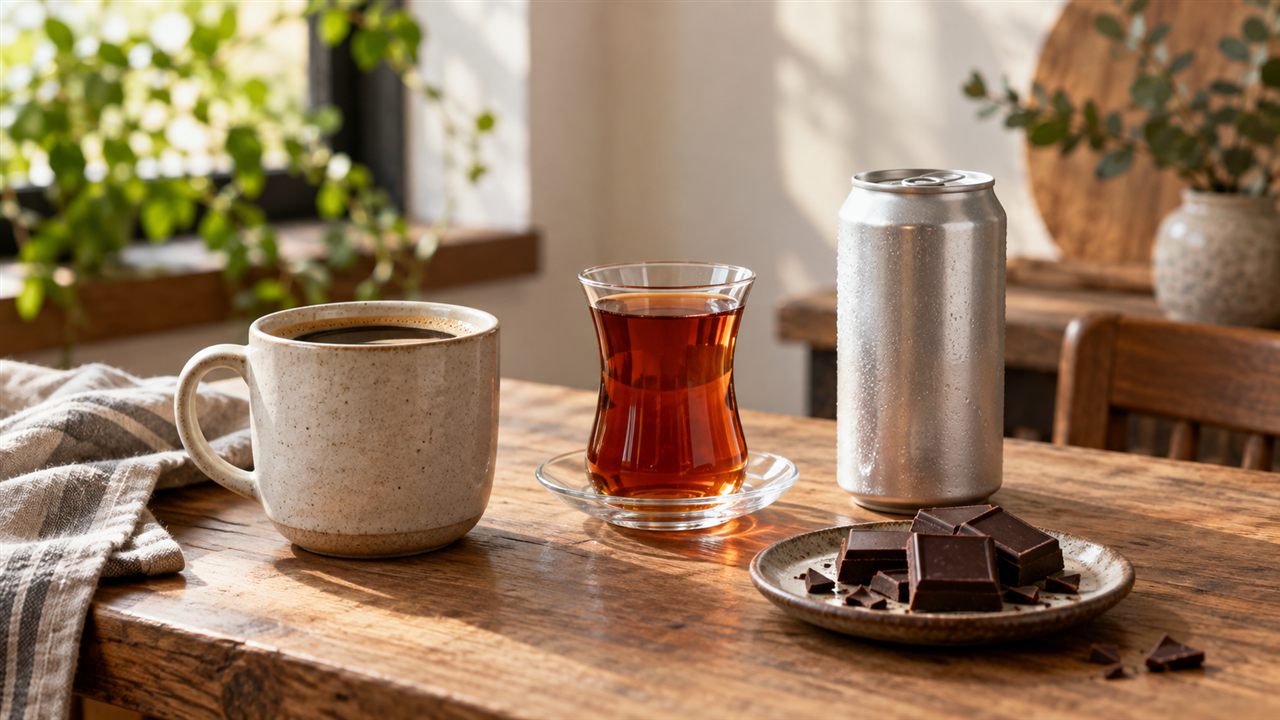
The practical question is not whether a drink looks strong or is marketed as natural. It is how much caffeine the relevant serving contains, how much you consume and when. Understanding the sources makes it easier to keep those separate questions in view.
Plants, ingredients and finished products
Caffeine can occur naturally in plant ingredients or be added during manufacturing. Coffee and tea are familiar examples of naturally caffeinated ingredients; a finished drink may also contain an added caffeine ingredient.
Those descriptions tell us where the substance entered the product, not whether the resulting dose is appropriate for a particular person. Natural is not a unit of measurement, and a plant-based label does not establish a low amount.
The FDA's caffeine overview explains that caffeine occurs in different foods and drinks and that products and personal responses vary. It also distinguishes ingredient labelling from quantitative information.
For tracking, the finished serving is usually the most useful unit. If a manufacturer provides a total that already includes naturally occurring and added caffeine, do not add those components again.
What historical surveys tell us
A US adult analysis of 2001–2010 survey data attributed roughly 64% of caffeine to coffee, 16% to tea and 18% to soft drinks. Those figures describe the studied adults and period; they are not a current market share for every American.
EFSA's 2015 caffeine assessment background described coffee as a major adult source in many European survey populations, while tea was especially important in the UK and Ireland. The underlying surveys and their assumptions predate this article.
These findings are useful precisely because they show that source patterns differ. They should not be promoted into a timeless claim that coffee supplies the same fraction of everyone's intake or that newer products remain a small source today.
A share of caffeine is not a share of drinks
Imagine a person drinks four beverages: two caffeine-free drinks, one tea and one coffee. Coffee accounts for one quarter of the beverage occasions, but it could supply a much larger fraction of the caffeine.
As a hypothetical calculation, suppose the tea contains 40 mg and the coffee 120 mg. Coffee then supplies 75% of the combined 160 mg, although there is only one serving of each caffeinated drink.
The numbers are illustrative, not standard values for every tea and coffee. They show why drink popularity and caffeine contribution should be reported separately.
The same distinction applies to spending. The product that costs most does not necessarily supply the most caffeine. Price, serving count, liquid volume and caffeine dose are different dimensions of the routine.
Population averages can hide very different days
A national average can combine non-consumers with occasional users and people who use several caffeinated products daily. It does not describe an actual person whose routine matches every mean value.
Even an individual's average can conceal important variation. A weekly average might look moderate while a particular day combines coffee, an energy drink and a late pre-workout product.
That matters when timing is the question. The same total spread across a morning is not equivalent, in a half-life model, to a large portion consumed near bedtime.
Our daily caffeine intake calculator helps organise amounts, while the main calculator adds timing. Both depend on the values entered and should be treated as estimates rather than measurements of blood caffeine.
Coffee is a category, not a fixed dose
Coffee can mean espresso, filter coffee, instant coffee, cold brew, a large milk drink or decaf. The dry coffee used, recipe, extraction and serving size all influence what ends up in the cup.
A larger cup does not always contain more coffee. In an espresso-based drink, extra milk or water may increase volume without adding another shot. In a batch brew, a larger pour generally changes the amount of the same prepared beverage consumed.
That is why a named recipe is preferable to a generic coffee entry when appropriate source information exists. Keep the market, size and source date attached to café figures.
The brewing-method guide explains why taste strength cannot substitute for caffeine measurement. Dark colour or bitterness is not a dependable way to calculate a dose.
Tea can contribute more than people expect
Tea is sometimes treated as a negligible source simply because a particular serving has less caffeine than a particular coffee. Frequency changes the total: several tea servings can make a substantial contribution over a day.
Preparation also matters. The amount of leaf, water volume, brewing conditions and repeated infusions complicate any attempt to give all tea a single value. Matcha involves consuming powdered leaf rather than removing the leaves after brewing.
Herbal infusions require ingredient checks rather than assumptions based on the word tea. Some products contain tea leaves or other caffeinated ingredients, while others do not.
See green tea, black tea and matcha for preparation differences. A lower-caffeine choice is most useful when it is based on the actual product and serving rather than the colour of the drink.
Energy drinks and sports drinks are not synonyms
Product names and shelf positions can make distinct categories look similar. A sports drink may focus on fluid and carbohydrate, while an energy drink may contain caffeine; individual products still need checking.
The relevant information is the label for the exact product in the relevant country. A brand can sell several ranges with different caffeine characteristics, and a familiar name does not establish that every bottle has the same formulation.
Our Lucozade range comparison illustrates why it is important to distinguish ranges rather than assign one figure to an entire brand.
If a label gives caffeine per 100 ml, multiply by the amount you drink. As an invented example, 30 mg per 100 ml means 150 mg in 500 ml. It does not mean 30 mg for the whole bottle.
Cola, sugar and caffeine need separate checks
Sugar-free does not mean caffeine-free. Sugar and caffeine are different ingredients, and removing one does not establish anything about the amount of the other.
Similarly, a regular version and a diet version may not share the same caffeine concentration. Country-specific formulations can differ even when the branding appears familiar.
The sugar-free versus caffeine-free guide explains how to read those claims separately. Check both the exact product name and the local label before transferring a number from another entry.
For someone trying to reduce caffeine, a caffeine-free version may serve a different purpose from a sugar-free version. Whether either is the right choice depends on the person's aims and circumstances, not on a single marketing word.
Chocolate, cocoa and food
Chocolate and cocoa can contribute caffeine even though they are not usually described as stimulant products. The amount depends on the product and portion, and a generic food-composition figure is not an exact result for every bar.
Chocolate also contains theobromine, a related but distinct compound. Its milligrams should not be added to a caffeine total as though the two were interchangeable.
Desserts can contain several sources at once. A coffee-flavoured chocolate dessert may include both coffee and cocoa; a recipe calculation needs to avoid counting an ingredient twice.
The chocolate and cocoa guide explains the arithmetic and the limits of cocoa-percentage shortcuts. A percentage printed on a bar is not a direct caffeine label.
Supplements and medicines need extra care
Some supplements and medicines contain caffeine. The relevant dose may be expressed per tablet, capsule, scoop or recommended serving rather than per container.
Follow the product directions and ask a pharmacist or clinician when you are unsure about a medicine or interaction. Do not change prescribed treatment because a calculator produces a particular total.
Multi-ingredient products can be difficult to interpret, especially when a label describes a blend without a clear caffeine quantity. An undocumented amount should remain uncertain; the name of a plant extract is not enough to calculate its contribution reliably.
Pure or highly concentrated caffeine is not an appropriate ingredient for casual kitchen-scale dosing. The FDA's overview warns about the serious risks of such products. A general drinks calculator is not a tool for making them safe.
Decaf reduces uncertainty only when the record is clear
Decaffeinated does not necessarily mean zero caffeine. A generic zero entered for every decaf drink can create a falsely reassuring total, especially when several servings are involved.
That does not make decaf unhelpful. It means the source and serving should remain visible, just as they should for regular coffee.
The decaf guide explains how to distinguish reduced caffeine from broader claims about health or processing. A drink can preserve many aspects of the coffee routine while changing the caffeine exposure substantially.
For a personal log, use a relevant documented value where available. If only a broad estimate is available, record that limitation rather than treating an uncertain number as a measured fact.
How dietary caffeine is estimated
Researchers typically need two sets of information: what participants report consuming and an estimate of the caffeine in those products. Multiplying quantity by composition produces an estimated intake.
Errors can enter at either stage. A participant may forget a drink, misremember its size or describe it generically. The composition database may not match the exact recipe or may use a category average.
A 2011–2012 US dietary analysis is one example of research connecting reported intake with food and beverage sources. Its population and period are part of the finding, not details to discard.
Such methods are valuable for population research, but they do not turn each estimated serving into a laboratory analysis. The uncertainty should remain visible when results are explained to readers.
Why age and survey coverage matter
A study of adults cannot automatically describe children or teenagers. Likewise, a survey of caffeine consumers differs from a survey that includes everyone, including those who report none.
Some studies focus on beverages and may not fully cover supplements or medicines. Others use a brief recall period that may miss occasional products. Different definitions can produce different totals without either study being fraudulent.
When comparing surveys, check the age range, country, recruitment method, recording period and included categories. Also check whether the reported mean applies to the whole sample or consumers only.
Those questions often explain more than a headline percentage. They prevent us from interpreting methodological differences as evidence that a country's habits changed dramatically between two unrelated studies.
Building a useful personal source list
Start with a normal day and list every potentially caffeinated item, including refills and products used around exercise. Record the amount actually consumed rather than the container's capacity if you drank only part of it.
Use the exact product and market when a label or manufacturer record is available. For homemade drinks, describe the recipe well enough that you can recognise changes later. Keep approximate values labelled as approximate.
Add the caffeine contributions, not the liquid volumes or ingredient weights. If a serving has a documented total, do not separately add caffeine from ingredients already included in it.
Repeat on more than one kind of day if your routine varies. A working day and a weekend may differ enough that one entry is not representative.
A worked example with explicit assumptions
Suppose a hypothetical day includes a 100 mg coffee, two 35 mg teas and a labelled 80 mg drink. The total is 100 + 35 + 35 + 80 = 250 mg.
Coffee provides 40% of that total, tea 28% and the other drink 32%. These percentages describe this invented example only. They are not recommendations or standard values for those categories.
Now replace the coffee with a documented 5 mg decaf serving while keeping the rest unchanged. The total becomes 155 mg and the source shares change, even though the person still has one coffee occasion.
This illustrates why beverage identity and caffeine contribution should not be confused. The practical change is in the dose supplied by the chosen serving, not in whether someone calls themselves a coffee drinker.
What a source list cannot tell you
A carefully recorded total still does not determine your sensitivity, sleep response or medical suitability. People differ, and a calculator's half-life setting is an assumption rather than a personal test.
The guide to individual caffeine differences explains metabolism, sensitivity and tolerance. These distinctions matter more than trying to match a national average.
If caffeine appears to cause troubling symptoms, or you need advice during pregnancy, with a medical condition or alongside medication, seek appropriate professional guidance. Do not use a population benchmark as permission to ignore your own circumstances.
The useful first step is simpler: identify the sources, keep serving assumptions visible and include timing when it matters. Better records make estimates more informative without making them more certain than the evidence allows.
Sources and editorial scope
AI-assisted educational synthesis by CaffCalc. Sources are linked alongside the relevant discussion. This is not a systematic review or an independently clinician-reviewed article. Research years and data limitations are stated in the text; publication today does not make historical findings current measurements.
- FDA's caffeine overview
- US adult analysis of 2001–2010 survey data
- 2015 caffeine assessment background
- 2011–2012 US dietary analysis
Health information is general education, not diagnosis or treatment advice. Read our source policy.