
Coffee and health · In-depth guide
Does coffee dehydrate you? Fluid intake, caffeine and exercise explained
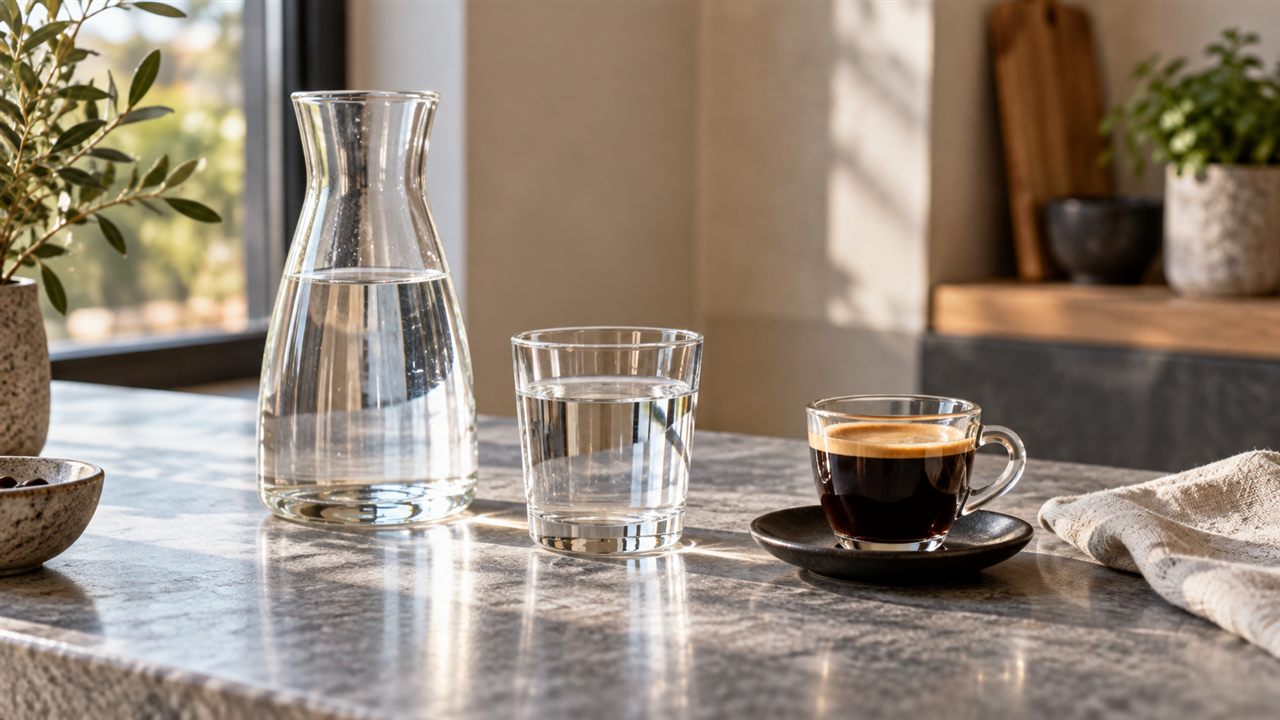
The confusion usually begins when “caffeine can make you urinate more” becomes “coffee must remove more water than it provides”. That second statement needs evidence about overall fluid balance, not just the number of trips to the toilet. This guide explains the distinction and where the available research should not be stretched.
Diuresis is not the same as dehydration
Diuresis means increased urine production. Dehydration concerns an overall deficit of body water. A drink can contribute water while also influencing urine output, and looking at only one side of that balance can lead to the wrong conclusion.
Think of a simple accounting example. If a hypothetical drink supplies 250 ml of fluid and changes urine output by some smaller amount, it would not follow that the drink contributed no fluid. This is an explanation of the logic, not a measurement of what one coffee does. Real hydration assessment is more complicated because food, other drinks, sweating, breathing and normal variation all matter.
The same reasoning explains why a single bathroom visit cannot tell you whether you are dehydrated. It is an observation, but not a complete fluid-balance measurement. If you have persistent urinary symptoms or a medical condition affecting fluid management, that deserves a different assessment from a general debate about coffee.
What the everyday guidance says
NHS hydration guidance includes tea and coffee among drinks that count towards daily fluid intake. It also treats the familiar six-to-eight-cups guide as a general starting point, with needs changing in circumstances such as heat, activity and illness. That is not a prescription to obtain all your fluid from caffeinated drinks.
For an ordinary day, it is useful to separate “does this contain fluid?” from “is this the drink I want repeatedly?” Water is convenient and avoids caffeine, while other drinks may contribute enjoyment or fit meals. A varied routine does not require proving that one beverage is the sole acceptable source of hydration.
If you have been advised to restrict or manage fluids because of a health condition, follow that individual guidance. General public advice is not designed to override clinical instructions. A caffeine calculator tracks neither electrolytes nor fluid status and cannot tell you how much water is right for a particular medical situation.
The frequently cited coffee-versus-water study
A 2014 crossover study compared coffee with water in 50 men who habitually drank coffee. Participants completed two three-day conditions, with four 200 ml servings and a coffee condition providing 4 mg caffeine per kilogram of body weight. The researchers found no significant difference across several hydration measures. The study received coffee-industry-related funding, which the authors disclosed.
Several details matter. This was not a study of everyone, every dose or every environment. The participants were habitual male coffee drinkers, the period was short, and other aspects of intake and activity were controlled. The result should not be promoted as permission for unlimited coffee or as treatment advice for someone already dehydrated.
The useful contribution is narrower: under those studied conditions, the assumption that moderate coffee necessarily dehydrates habitual drinkers was not supported. Reading the participant group and protocol is more informative than remembering only a headline about coffee being equivalent to water.
Why researchers use more than urine volume
A hydration study may consider body water, urine concentration, blood measures, body mass and recorded intake. Each provides a different view, with practical limitations. A change in one measure does not necessarily settle the entire question, particularly over a short interval.
For example, the timing of a measurement matters. A sample immediately after a large drink may look different from one taken many hours later. Body mass can also change for reasons other than a simple change in hydration. Good research attempts to standardise relevant conditions and interpret measures together.
This is one reason a casual home comparison is not equivalent to a controlled trial. You do not need to perform laboratory testing to choose your drinks, but it helps to understand why a personal observation cannot establish a universal physiological rule. “I went to the toilet more after that coffee” is a narrower statement than “coffee caused dehydration”.
The serving contains water and caffeine
Two coffees can supply very different fluid volumes for a similar caffeine dose. A small espresso and a diluted espresso-based drink illustrate the distinction: adding water increases beverage volume without adding caffeine, assuming the coffee component stays unchanged. A larger drink made with additional coffee changes both.
Consider an illustrative 60 mg coffee serving. Adding 150 ml of water does not turn the dose into less than 60 mg if the whole drink is consumed. It lowers caffeine concentration, expressed per 100 ml, while the total remains unchanged. That distinction is useful for both hydration discussions and caffeine comparisons.
Milk-based drinks introduce additional ingredients but follow the same arithmetic principle. Cup size alone cannot establish caffeine content, and caffeine content alone cannot establish fluid volume. If you track both for a particular reason, record them as separate quantities rather than trying to convert one into the other.
Why caffeine-free options may still be useful
Recognising coffee’s fluid contribution does not mean it suits every time of day. Someone may choose water or a caffeine-free drink to avoid late caffeine, unwanted stimulation or an inconvenient routine. That is a practical decision, not a contradiction of hydration research.
Decaf can also preserve the flavour or ritual while reducing caffeine. It usually contains some residual caffeine, so check the relevant serving if that matters. Our decaf guide distinguishes reduced caffeine from a guaranteed zero and explains why a prepared-serving figure is more helpful than a removal percentage alone.
It is perfectly reasonable to choose a non-caffeinated drink without first proving that regular coffee is harmful. Conversely, someone who enjoys a normal coffee does not need to drink an arbitrary extra glass of water solely to “repay” it. A fixed repayment formula is not established by the evidence discussed here.
Exercise changes the context
During prolonged activity, fluid needs are influenced by conditions, duration, sweat losses and the individual. Whether a coffee contributed water earlier in the day is not a complete hydration plan for exercise. Neither is the caffeine amount printed on a pre-workout product.
Separate the purposes of a sports product. It might be intended to supply fluid, carbohydrate, electrolytes or caffeine, or some combination. These are not interchangeable functions. A concentrated caffeine product can provide a stimulant dose with little fluid; a non-caffeinated drink can provide fluid without any stimulant.
Avoid turning a general coffee article into a personalised endurance-hydration prescription. If you train or compete in demanding conditions, use appropriate sports-nutrition guidance and qualified advice where needed. Do not deliberately increase caffeine or force large volumes of water as an experiment based on a general claim that one offsets the other.
Hot weather does not make coffee a fluid plan
Heat can change how much fluid you need and how practical different drinks feel. A drink’s temperature, convenience and availability may influence what you choose, but “hot coffee” and “iced coffee” are not enough information to assess a day’s intake.
An iced drink may include ice that is not fully consumed, while a concentrate can be diluted in different ways. A large cup also may not be finished. If quantities matter, distinguish the advertised container volume from the amount actually drunk rather than assuming they are identical.
For routine decisions, keep accessible drinks available and follow relevant public-health advice during hot conditions. Do not interpret this guide as evidence that a caffeinated beverage is uniquely protective against heat illness. The hydration study described earlier did not establish that claim, and ordinary indoor routines are not equivalent to extreme environmental exposure.
Treating dehydration is a separate question
The NHS page on dehydration gives advice for symptoms, illness-related fluid losses and when to seek help. It recommends avoiding caffeinated drinks in that treatment context and explains that a pharmacist may recommend an oral rehydration solution when vomiting or diarrhoea causes losses. That advice addresses a different situation from everyday beverage contribution.
It would be misleading to use a study in healthy habitual coffee drinkers to dismiss advice for someone who is ill. The person, starting condition and purpose are different. “Counts towards routine fluid intake” does not mean “recommended treatment for dehydration”. Both statements can be understood once the contexts are separated.
Seek appropriate help for concerning symptoms, especially persistent dizziness, unusually low urine output, marked drowsiness or difficulty keeping fluids down. Follow guidance specific to babies, children and vulnerable adults. A coffee article cannot assess the severity of dehydration remotely.
Bladder symptoms are not a hydration score
A person can find caffeine inconvenient because of urgency or frequency even without a demonstrated whole-body water deficit. NHS bladder-and-bowel guidance discusses fluid and caffeine management in that specific context. It should not be flattened into a universal claim about all drinkers.
If you notice a pattern, the useful information includes the drink, portion, timing and symptom, not just a label such as dehydrating. Very large drinks, changes in routine and other factors may also matter. A simple record can support a discussion with a professional without becoming a self-diagnosis.
Do not respond to persistent urinary symptoms by severely restricting fluid on your own. The fact that a drink prompts bathroom visits does not establish how much you should drink overall. Symptoms and medical circumstances need their own assessment rather than an improvised caffeine-versus-water rule.
Common myths and better questions
“Coffee does not count as water” is too absolute for routine hydration. “Coffee is exactly the same as water” is also too broad because caffeine and other ingredients can matter. A better question is whether the drink contributes fluid and whether its other characteristics suit your situation.
“Clear urine all day proves perfect hydration” also turns an imperfect observation into a score. Public guidance uses practical signs, but individual conditions and medicines can affect interpretation. You do not need to chase an extreme visual target or drink beyond comfort because a website suggests more water is always better.
Finally, “a headache after coffee means dehydration” identifies a cause without enough evidence. Headaches have many possible explanations, including changes in a habitual caffeine routine. Persistent, severe or unusual symptoms deserve assessment rather than repeated self-treatment with either caffeine or water.
A practical record that avoids false precision
If you want to understand your routine, record the approximate drinks you actually finish over several ordinary days. Note whether the day involved heat, exercise, illness or unusual activity. Keep caffeine amounts and fluid volumes separate, and mark uncertain values as estimates.
Do not subtract a made-up water penalty for every coffee. There is no universal number in this guide that supports doing so. Likewise, do not convert a caffeine half-life graph into a hydration graph: those models describe different quantities and require different information.
The value of a record is to reveal patterns and make a conversation more concrete. It is not to diagnose dehydration or prove that one drink caused a symptom. If there is no particular concern, a complicated tracking routine may be unnecessary; ordinary accessible drinks and appropriate guidance are a simpler starting point.
The takeaway
Coffee can contribute to everyday fluid intake, and increased urine production is not automatically dehydration. That conclusion has boundaries: illness, demanding exercise, bladder symptoms and medical fluid advice deserve their own context.
Use water and other suitable drinks according to your circumstances, and consider caffeine for its separate effects on your routine. If you want to compare caffeine timing, use our calculator. If you need help with dehydration or ongoing symptoms, use healthcare guidance rather than a beverage comparison tool.
Sources and editorial scope
AI-assisted educational synthesis by CaffCalc. Sources are linked alongside the relevant discussion. This is not a systematic review or an independently clinician-reviewed article. Research years and data limitations are stated in the text; publication today does not make historical findings current measurements.
Health information is general education, not diagnosis or treatment advice. Read our source policy.