
Coffee and health · In-depth guide
Coffee and cholesterol: does your brewing method matter?
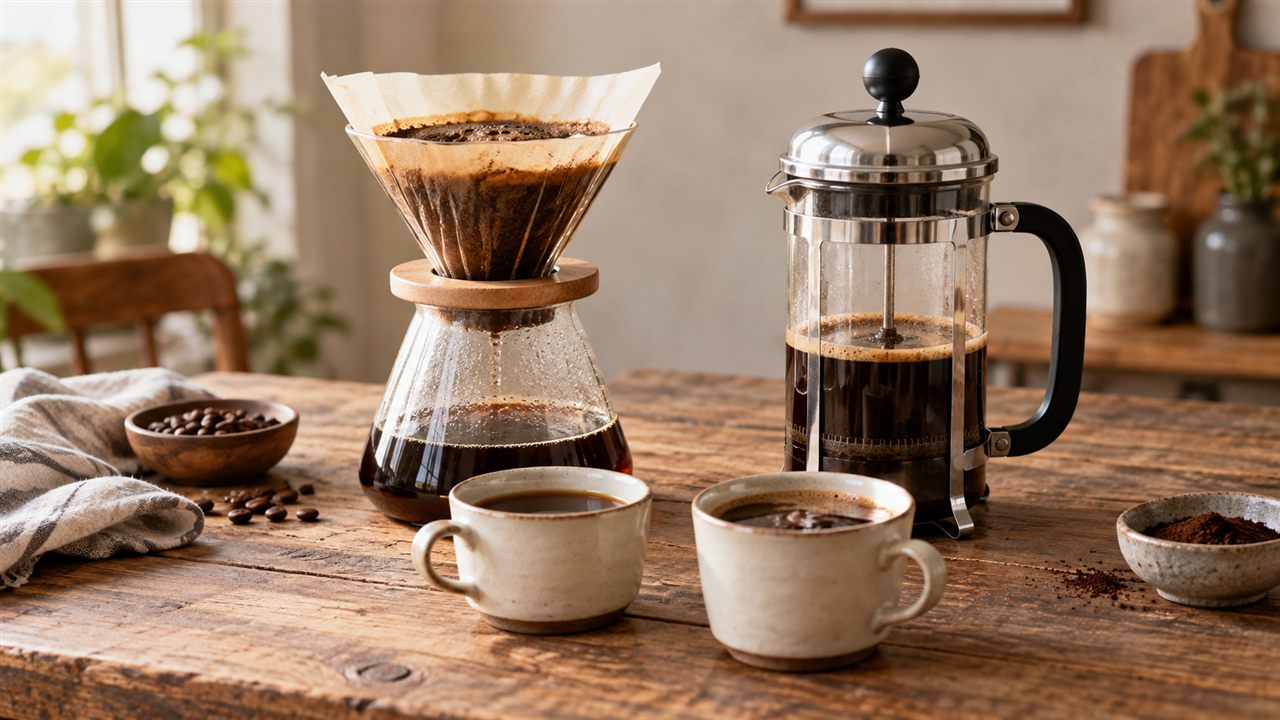
That does not mean an individual can predict a blood-test result from their brewer, or that a filter makes every aspect of a drink healthy. It means preparation deserves a place in the conversation, particularly for someone already discussing cholesterol with a clinician. This guide explains the evidence without turning equipment into treatment.
Caffeine and coffee oils are different things
Caffeine is the stimulant most people associate with coffee. Cafestol and kahweol are different compounds, classed as diterpenes and associated with coffee’s lipid fraction. The cholesterol question involves these constituents, not a rule that every milligram of caffeine produces a corresponding cholesterol increase.
This distinction prevents two common mistakes. First, decaf does not automatically answer a question about coffee oils. Second, passing regular coffee through a paper filter does not turn it into decaf. Reducing one component does not imply the same reduction in another.
If you are comparing products, decide which property you want to understand. For caffeine, use serving-specific information. For filtration, identify the actual material and method. For the overall recipe, consider milk, cream and other additions separately. A single label such as strong, smooth or premium cannot stand in for all of these details.
What paper-filter experiments found
In a 1991 crossover experiment, 20 volunteers consumed strong boiled coffee or the same type of coffee passed through a paper filter during separate four-week periods. Several blood lipid measures were higher during the unfiltered condition. The filtering process removed much of the measured lipid-soluble material. This was a small, specific experiment, not a prediction for every drinker.
The useful feature of that design is the direct preparation comparison. Instead of contrasting people who independently chose different drinks, the researchers changed the filtering condition. That provides evidence about a mechanism that a general coffee questionnaire cannot isolate as clearly.
However, the serving amounts and preparation still matter. You cannot take a result from substantial daily consumption of strong boiled coffee and assign the same numerical effect to one occasional espresso. The experiment supports distinguishing methods; it does not supply a universal cholesterol calculator.
Evidence from longer randomised trials
A 12-week trial involving 107 young adults compared filtered and boiled coffee and found a greater rise in total cholesterol in the boiled-coffee group. A later six-month cafetière-versus-filtered trial investigated related questions over a longer period. These studies help establish that preparation is more than a flavour detail.
When reading older trials, age alone is not a reason to dismiss the underlying mechanism. But the study’s methods, population and exposure should remain visible. Coffee equipment and habits vary, and the exact result of an older protocol cannot be assumed to describe every modern café order.
Also distinguish changes in a biomarker from changes in disease outcomes. A cholesterol measurement is clinically relevant, but a brewing trial measuring blood lipids does not directly measure the number of future heart attacks prevented by buying a particular filter. That additional claim would require additional evidence.
What about espresso?
Espresso is not normally paper-filtered in the same way as a pour-over, but it is usually consumed in a smaller volume than a mug of filter coffee. Both composition and portion therefore matter. Classifying a method as unfiltered does not mean every serving supplies the same amount of coffee oils.
The Tromsø Study analysis published in 2022 examined espresso and other brewing methods in more than 21,000 adults aged at least 40. It found associations between some coffee-consumption categories and total cholesterol. Because it was cross-sectional, it could not establish that a particular person’s espresso habit caused a measured change.
This is an example of evidence worth discussing without exaggerating. A large observational study can reveal a pattern but still have limitations in drink reporting, confounding and timing. The answer is not to ignore espresso or declare it dangerous; it is to keep the conclusion proportional to what was actually measured.
A practical map of brewing methods
The following is a preparation guide, not a medical ranking. Equipment configurations differ, so the filter actually used matters more than a broad marketing name.
| Method | Filtration to check | Important limitation |
|---|---|---|
| Paper-filter pour-over or drip | Disposable or reusable paper filter | Still contains caffeine; recipe and serving vary |
| Cafetière or French press | Usually a metal mesh | Mesh is not equivalent to paper filtration |
| Espresso | Usually a metal basket | Small serving and number of shots both matter |
| Cold brew | Depends on final filtration | Cold extraction does not identify the filter |
| Reusable-filter machine | Metal, fabric or another material | Do not assume all reusable filters behave alike |
This table deliberately does not provide a number of milligrams of diterpenes per cup. Such a figure would need a specific recipe and measurement source. A qualitative distinction can be useful without pretending to know the exact composition of every homemade drink.
Cold brew is not a filtration category
Cold brew describes an extraction approach, not the complete filtration process. A concentrate strained through a coarse mesh and one passed through a paper filter may both be called cold brew. Their shared temperature description does not establish that they contain identical amounts of oils or caffeine.
Dilution adds another variable. A concentrate and a ready-to-drink product are not comparable by cup size alone. If a product supplies a prepared-serving figure, follow its intended dilution before comparing it with another beverage. Do not assume that a smooth flavour indicates low caffeine or a favourable lipid profile.
For someone trying to understand an everyday order, asking how it is filtered can be more informative than asking whether it is cold brewed. If the manufacturer does not provide details, mark that uncertainty instead of assigning the product a precise health category based on its name.
Why decaf does not settle this question
Decaffeination reduces caffeine before the final drink is prepared. Filtration affects what passes into the cup during preparation. They are separate processes. A decaf coffee still needs a brewing description if the question concerns coffee oils rather than stimulant exposure.
That does not make decaf an unsuitable choice. It simply prevents one benefit from being used to imply another. Someone may choose paper-filtered decaf because they want to consider both caffeine and preparation, but the decision should not be advertised as a guaranteed treatment for high cholesterol.
Our decaf article explores the residual-caffeine and processing questions separately. Keeping the topics connected but distinct makes it easier to compare actual drinks instead of searching for a single word that guarantees every desirable property.
Blood cholesterol is not a feeling
You cannot tell whether a drink has changed cholesterol because it feels smooth, causes no jitters or seems easy to digest. Those experiences concern different outcomes. Equally, a strong-tasting coffee does not prove that it contains more cholesterol-raising compounds.
Blood-test interpretation belongs in a wider clinical context. Age, family history, other conditions, medicines and the overall risk assessment can matter. An isolated coffee habit does not explain every result, and a general article cannot determine whether a brewing change is sufficient for an individual.
If you are concerned, describe your routine accurately to the professional advising you: preparation, approximate amount, frequency and additions. That information can support a discussion. Do not stop prescribed medication or delay recommended care because you have switched filters and expect a particular numerical improvement.
What long-term observational research adds
A large Norwegian cohort study examined brewing methods in relation to mortality. Its findings add context to questions about preparation, but they remain observational. The study cannot prove that replacing a cafetière with a paper-filter brewer changes an individual’s lifespan.
The temptation is to combine a plausible mechanism, a blood-marker trial and a cohort association into a stronger claim than any one source supports. Together they can make a coherent case for taking brewing method seriously. They do not remove all uncertainty about dose, confounding or individual benefit.
This is why the article focuses on a practical distinction rather than a promise. “Tell your clinician that you drink several unfiltered servings” is a different type of advice from “this filter will prevent heart disease”. The first respects the evidence and the limits of a general information resource.
How much coffee are you actually describing?
Cup counts are convenient but imprecise. A small espresso, a large mug and a whole cafetière poured into several cups are not equivalent units. The amount of ground coffee and the fraction of the brew you consume can be more informative than the number of vessels.
If you want to describe your routine, note the brewer, whether paper is used, the approximate final volume and how much you drink. For an espresso-based order, record the shot count if known. You do not need to produce a laboratory analysis; the goal is to avoid a misleadingly vague description.
Do not convert these details into a made-up personal diterpene dose. Without appropriate composition data, that would add false precision. A clear description of an uncertain exposure is more useful than an exact-looking number derived from a generic table that does not match your method.
Making a change without overinterpreting it
If you decide to try paper-filtered coffee, use equipment according to its instructions and choose a recipe you enjoy. Keep the purpose clear: you are changing filtration, not demonstrating that every other feature of the drink has improved. Caffeine may remain similar or change if the recipe also changes.
If taste leads you to increase the amount of coffee or the number of servings, the overall routine has changed again. The effect cannot be understood by looking only at the filter. Similarly, switching to a different café beverage can change milk, sugar and portion size at the same time.
For a medically motivated change, agree with your clinician how it fits into the broader plan and whether any follow-up is appropriate. Avoid repeated home experiments based on a single blood result without considering normal variation and other changes. The aim is sensible care, not a brewing competition.
Questions to ask when buying equipment
If you already own a brewer, check its instructions before buying a replacement. A machine described casually as a filter coffee maker may use a permanent metal basket, disposable paper, or both in a specific configuration. That distinction can be lost when the same product category is used for very different designs. Describe the filter material when discussing your routine with a clinician, and do not improvise a modification that conflicts with the manufacturer's instructions. Understanding the existing setup may be more useful than assuming an expensive upgrade is necessary.
Does the brewer use paper, metal mesh or another material? Can the manufacturer explain the intended filter configuration? Is a reusable insert an alternative to, or used alongside, paper? These practical questions are often easier to answer than broad claims about healthy coffee.
Do not assume an expensive machine provides better evidence-based health properties. Price can reflect convenience, build quality, temperature control or design, none of which automatically establishes a specific clinical benefit. A simple product with a clearly described method may be easier to understand.
Also avoid treating a manufacturer’s laboratory claim as a clinical guarantee. A measured reduction in a compound under one test condition is useful information, but the study protocol and finished recipe still matter. If a claim cannot be traced beyond promotional language, it should not drive a medical decision.
The balanced conclusion
There is a sound reason to distinguish paper-filtered coffee from preparations that retain more oils when discussing cholesterol. Experimental and observational evidence address different parts of that question. Neither supplies a universal prediction of an individual’s blood results or disease risk.
Describe the actual method, keep caffeine and coffee oils separate, and follow personal advice if cholesterol is a concern. For another dimension of brewing, see how preparation changes caffeine. A useful comparison answers a specific question well instead of labelling one brewer healthy and every other one harmful.
Sources and editorial scope
AI-assisted educational synthesis by CaffCalc. Sources are linked alongside the relevant discussion. This is not a systematic review or an independently clinician-reviewed article. Research years and data limitations are stated in the text; publication today does not make historical findings current measurements.
- 1991 crossover experiment
- 12-week trial involving 107 young adults
- six-month cafetière-versus-filtered trial
- Tromsø Study analysis published in 2022
- large Norwegian cohort study
Health information is general education, not diagnosis or treatment advice. Read our source policy.